E-Way Bill Rules for Road Freight: Limits, Validity and Part B
Table of Contents
The core e-way bill rules are straightforward to state and easy to get wrong in practice. An electronic e-way bill is required before goods worth more than Rs 50,000 move, it is generated in two parts, and it stays valid for one day per 200 km of the declared journey. Almost every detained vehicle involves a failure in one of those three areas rather than ignorance of the requirement itself.
This guide sets out what the e-way bill rules actually say, where the common operational failures occur, and what a dispatch desk should check before a consignment leaves. The regulatory position described is current as of September 2026.
The e-way bill limit and when it applies
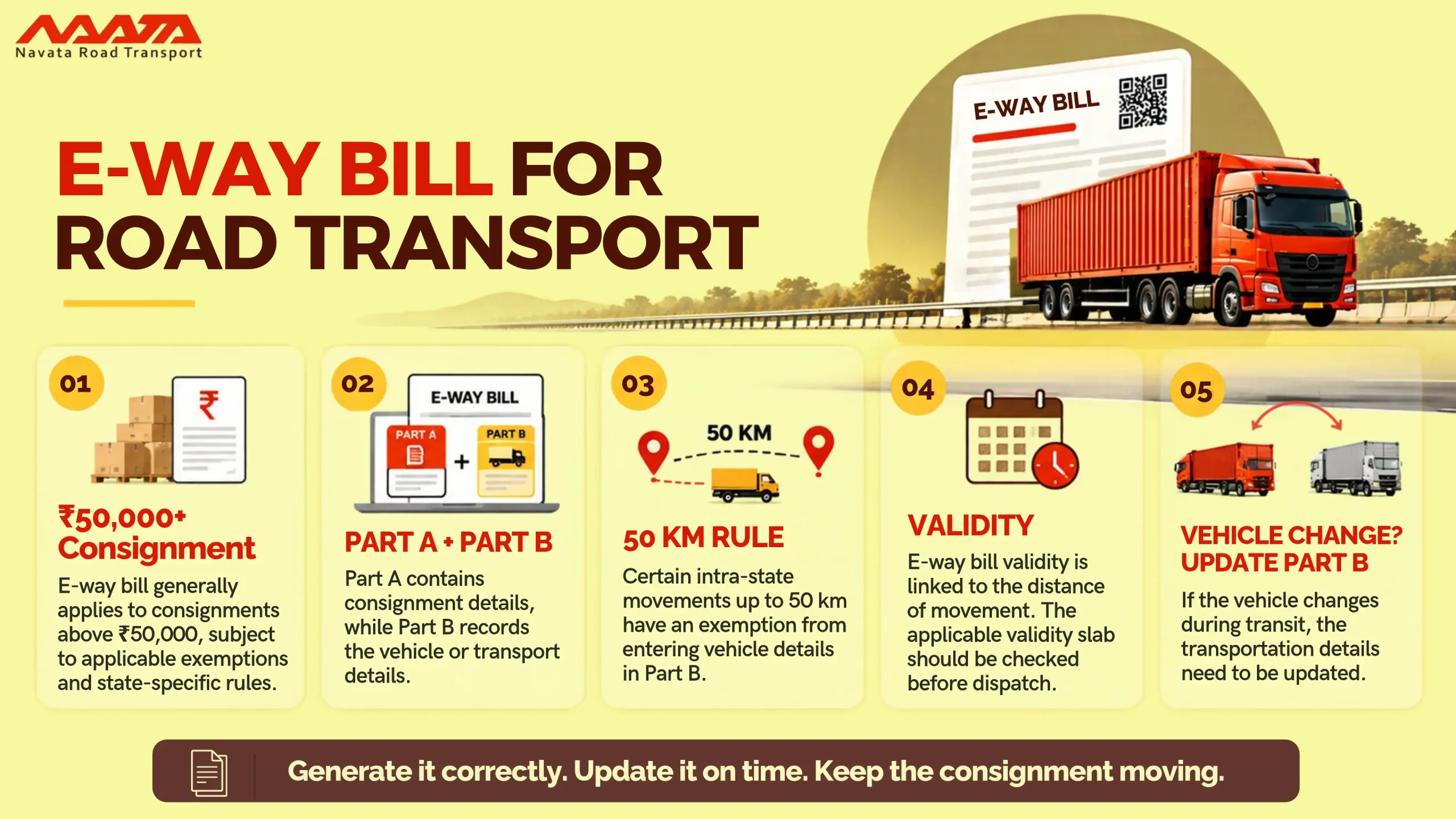
The e-way bill limit under Rule 138 of the CGST Rules is a consignment value exceeding Rs 50,000. That figure is the value declared in the invoice, bill of supply or delivery challan, including the tax charged on it, but excluding the value of exempt supply where a single invoice covers both taxable and exempt goods.
Two points about the limit are routinely misunderstood.
First, the requirement is not restricted to sales. Branch transfers, stock movements between your own godowns, sales returns, movement for repair, and inward movement from an unregistered supplier all count as movement of goods and attract the requirement.
Second, the question of aggregation. Rule 138(7), which would have required a transporter to generate an e-way bill where several individually sub-threshold consignments in one vehicle add up to more than Rs 50,000, has been deferred and is not in operation. In practice, the threshold is applied per consignment. This is not a settled position, however, because some High Courts have taken a stricter view where multiple invoices form a single consignment, so a vehicle carrying many small invoices for one buyer is not a safe structure to rely on.
Two categories require an e-way bill regardless of value:
- Interstate movement of goods from a principal to a job worker
- Interstate movement of handicraft goods by a dealer exempt from GST registration
State variation matters. Rs 50,000 is the uniform threshold for interstate movement. For movement wholly inside one state, several states have notified higher intra-state thresholds, commonly Rs 1,00,000, and Rajasthan operates differentiated limits for movement within and between cities. Check the notification of the state in which the movement takes place before applying a threshold to a local trip.
Who generates it: e-way bill for transporter, consignor and consignee
Responsibility moves down the chain to whoever is in a position to act.
| Situation | Who generates |
|---|---|
| Registered supplier causing the movement | The supplier, before movement begins |
| Registered recipient arranging collection | The recipient |
| Goods handed to a road transporter and neither party has generated it | The transporter, on the basis of information furnished by the registered person |
| Supplier unregistered, recipient registered | The registered recipient |
| Transporter not registered under GST | Enrols on the portal and generates against a Transporter ID (TRANSIN) |
For a transport operator the practical position is that an e-way bill for transporter obligations does not lapse because the consignor was slow. Where goods are handed over for road movement and no bill exists, the transporter is expected to generate it from the details supplied.
Rule 138(5A) allows the consignor or recipient to assign the e-way bill number to another enrolled transporter for updating. Once assigned, the original party can no longer update Part B, which is worth knowing before a consignment changes hands mid-route.
Part A and Part B of e-way bill
The document has two halves and they behave differently.
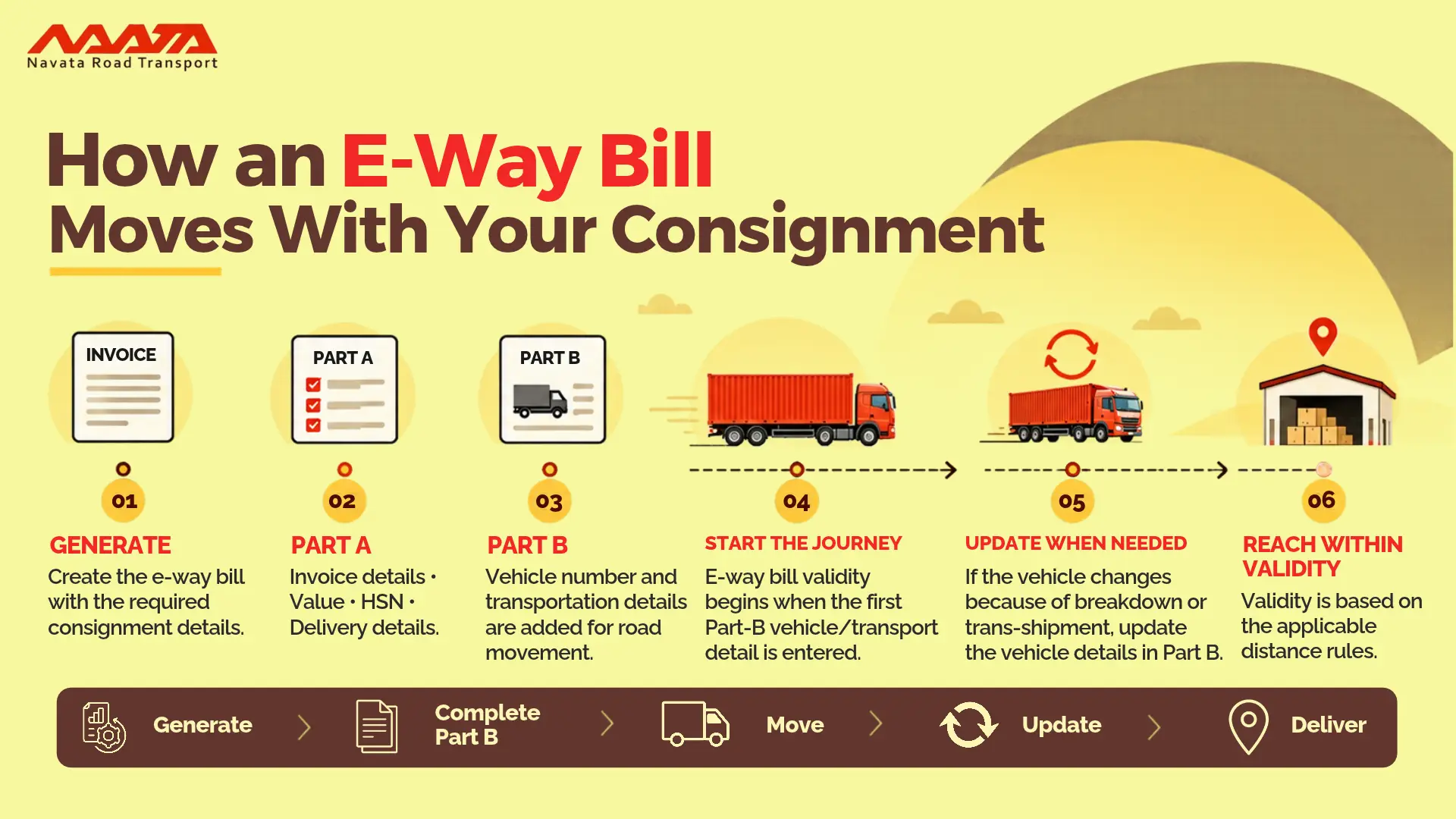
Part A carries the consignment: recipient GSTIN, delivery PIN code, invoice or challan number and date, value of goods, HSN code, and the reason for transportation. It is normally completed by the party raising the document.
Part B carries the conveyance: vehicle number, or the transport document number where the leg moves by rail, air, or vessel. It is normally completed by the transporter.
Three properties of Part B of the e-way bill decide whether the document survives the trip.
You may also like to read
E-documentation in Road Transportation
1. Validity starts at Part B.
A Part A generated on Monday for a vehicle loaded on Wednesday does not lose two days of validity. The clock starts when conveyance details are first entered.
2. Part B can be omitted on short first and last legs.
Where goods move up to 50 km within the same state from the consignor’s place of business to the transporter’s premises for further transportation, conveyance details need not be furnished. The same relief applies to the final leg from the transporter’s premises to the consignee inside the state. This covers pickup and delivery legs, not the line haul, and it does not remove the requirement for the e-way bill itself.
3. Part B must be updated at every transhipment.
A change of vehicle without a Part B update leaves a valid document describing the wrong truck, which is treated as a contravention.
How e-way bill validity is calculated
E-way bill validity runs on a distance slab, counted from the time the bill was generated, not from the invoice date and not from dispatch.
| Consignment type | Validity |
|---|---|
| Other than over dimensional cargo | One day for up to 200 km, plus one additional day for every 200 km or part thereof |
| Over dimensional cargo, and multimodal movement including a vessel leg | One day for up to 20 km, plus one additional day for every 20 km or part thereof |
The slab was widened from 100 km to 200 km with effect from 1 January 2021. “One day” ends at midnight of the day immediately following the relevant date, which means the first day is almost never a full 24 hours. A bill generated at 6 pm has roughly 30 hours in its first day; one generated at 6 am has roughly 42.
Worked examples on the 200 km slab:
- 180 km declared distance: one day
- 310 km: two days
- 600 km: three days
- 610 km: four days
Over dimensional cargo runs on the 20 km slab, so a 400 km ODC movement carries twenty days of validity rather than two. If you move ODC, the escort and route clearance constraints usually bind before the paperwork does. The category itself is explained in our note on over dimensional cargo.
One practical detail that causes disputes: the portal computes distance from the PIN codes entered, using the map distance, and permits the user to declare up to 10 percent more than that computed figure. If your actual route is longer than the PIN-to-PIN distance because of a restriction or a detour, the declared distance, and therefore validity, may be short before the truck has done anything wrong.
Extension, cancellation and rejection
Extension
Validity can be extended within a window of eight hours before expiry to eight hours after it. Outside that window there is no extension and the consignment needs a fresh e-way bill against the same document. Since 1 January 2025 the total extension is capped at 360 days from the original generation date.
Cancellation
An e-way bill can be cancelled electronically within 24 hours of generation, provided it has not already been verified in transit by an officer. A bill that is generated and then not used should be cancelled rather than left open.
Rejection
The counterparty can reject a bill raised against their GSTIN. If they take no action within 72 hours of the details being made available, or before delivery, whichever is earlier, it is deemed accepted. Any business that does not periodically check bills raised against its own GSTIN is accepting them by default.
There is no official “close on delivery” facility in the e-way bill system. Operational hygiene therefore relies on cancelling unused bills within 24 hours and on not extending anything that no longer needs to move.
The 2025 system changes that still catch shippers out
Three system-level changes took effect on 1 January 2025 and continue to cause preventable failures.
180-day document age limit. An e-way bill cannot be generated against a document dated more than 180 days before the date of generation. Old stock moving against an old invoice needs a fresh document raised for the movement.
360-day ceiling on extensions. No consignment can be kept alive on repeated extensions beyond 360 days from the original generation.
Multi-factor authentication. MFA was phased in by aggregate turnover, becoming mandatory for taxpayers above Rs 20 crore from 1 January 2025, above Rs 5 crore from 1 February 2025, and for all users from 1 April 2025. A shared dispatch login tied to a mobile number nobody can reach at 11 pm is now an operational risk, not just a security one.
The second portal most dispatch desks still do not use
NIC runs a second e-way bill portal at ewaybill2.gst.gov.in, live since 1 June 2024 under the GSTN advisory issued on 29 May 2024. It operates in parallel with the main portal from a separate location and synchronises within seconds.
What it gives an operating transport desk:
- The same login credentials. No separate registration.
- Generation, cancellation, printing, and vehicle and transporter updates, through the web interface and through API.
- Criss-cross Part B updates. A bill generated on the main portal can have its Part B updated on the second portal, and the reverse.
- Independent working during a main-portal outage.
The last two matter most. A vehicle waiting at a transhipment point while the main portal is down is a solved problem, and the solution has been available since June 2024. Any dispatch desk that stops work when the main portal is unreachable should have the second portal configured and tested before it is needed, not on the day it is needed.
When your GSTIN is blocked from generating
Under Rule 138E, a GSTIN that has not filed returns for two consecutive tax periods is blocked from e-way bill generation. The block applies to the GSTIN as supplier, recipient and transporter, so a customer’s filing default can stop your vehicle as effectively as your own.
Two consequences follow for a transport operation. Check counterparty status before committing a vehicle to a lane on credit, and treat return filing as a dispatch dependency rather than a purely finance matter.
What actually causes detention
Detention rarely follows from not knowing the rule. It follows from routine handling.
- Validity expiring on a delayed trip. A breakdown, a long checkpost queue or a monsoon detour consumes the slab. Track expiry time, not distance covered.
- Vehicle number not updated after transhipment. Every change of conveyance needs a Part B update on the same bill.
- Declared distance shorter than the real route. See the PIN code point above.
- Mismatch between invoice and bill. Wrong consignee GSTIN, wrong value or wrong HSN.
- Expired or unassigned bills on a multi-consignment vehicle. A consolidated e-way bill in FORM GST EWB-02 may be generated where one vehicle carries several consignments. It is a trip sheet, not a substitute: each underlying bill keeps its own validity, and the consolidated document does not extend any of them.
- Bills generated and never cancelled. These distort your own records and complicate reconciliation later.
Documentation discipline across the movement, not just at generation, is what keeps these from becoming detentions. Related operational practice is covered in our note on e-documentation in transportation.
Penalties and what they cost
The penalty position changed on 1 January 2022 and older figures still circulate widely.
Where goods are detained for moving without a valid e-way bill, Section 129 of the CGST Act applies:
| Situation | Penalty |
|---|---|
| Owner comes forward, taxable goods | 200 percent of the tax payable |
| Owner comes forward, exempt goods | 2 percent of the value of goods or Rs 25,000, whichever is lower |
| Owner does not come forward, taxable goods | 50 percent of the value of goods or 200 percent of the tax payable, whichever is higher |
| Owner does not come forward, exempt goods | 5 percent of the value of goods or Rs 25,000, whichever is lower |
Notice of penalty is to be issued within seven days of detention and the order passed within seven days of the notice. A conveyance can be released on payment by the transporter of the penalty applicable or Rs 1,00,000, whichever is less.
The widely quoted figure of Rs 10,000 comes from the general penalty provision in Section 122 and is not the detention penalty. Separately, Circular 64/38/2018 directs that genuine minor discrepancies, such as a spelling error, a wrong PIN code, an error in one or two digits of a document number, or a minor vehicle number error, attract a nominal penalty of Rs 1,000 rather than the Section 129 consequence, provided there is no evasion. Knowing this circular exists is often worth more at a checkpost than knowing the penalty table.
In most detentions the direct penalty is not the largest cost. Vehicle idle time, missed delivery windows and the cost of the consignee’s stopped line usually exceed it. Managing that exposure is part of wider road transportation risk management.
Pre-dispatch checklist
- Confirm the consignment value against the threshold applicable to that movement, interstate or the relevant state’s intra-state limit.
- Confirm the invoice or challan is dated within 180 days.
- Generate Part A with correct consignee GSTIN, HSN and delivery PIN code.
- Check the system-computed distance against the real route, and declare within the permitted margin.
- Enter Part B only once the vehicle is assigned, so validity starts when the truck does.
- Calculate expiry against realistic transit time including rest hours, not best-case running.
- Brief the driver on when validity expires and whom to call before it does.
- Update Part B at every transhipment.
- Cancel unused bills within 24 hours.
- Review bills raised against your GSTIN inside the 72-hour rejection window.
FAQs
Is an e-way bill needed for a movement of less than 50 km?
Yes, if the consignment value crosses the applicable threshold. The 50 km relief removes the need to furnish Part B on the leg between the consignor and the transporter, or the transporter and the consignee, inside the same state. It does not remove the e-way bill.
Can validity be extended after it expires?
Yes, but only within eight hours after expiry, and subject to the 360-day overall cap. Beyond that window the consignment needs a fresh bill.
Who is responsible if the consignor did not generate the bill?
Where goods are handed to a road transporter without a bill, the transporter is expected to generate one from the details furnished by the registered person.
Does the Rs 50,000 limit apply to each invoice or to the whole vehicle?
It is applied per consignment. The sub-rule that would have aggregated several small consignments in one vehicle has been deferred, though courts have taken a stricter view where multiple invoices form a single consignment.
What happens if the vehicle breaks down?
Transfer the goods to another conveyance and update Part B against the same e-way bill before the movement resumes. If validity will lapse during the delay, use the eight-hour extension window rather than letting it expire.
Moving the consignment
Compliance is the first half of a dispatch. The second half is a network that can update a bill from wherever the vehicle actually is, and staff at the branch who know what a checkpost will ask for.
Navata Road Transport has moved road freight since 1982, with a branch network across South India and several states beyond it. To plan a specific movement, use the freight calculator or find your nearest Navata branch. For transportation, warehousing and 3PL, see our range of logistics services.
This article describes the position under the CGST Rules and related GSTN advisories as of 24 September 2026. E-way bill provisions are amended periodically, state-level intra-state thresholds differ, and the treatment of specific consignments can vary. Verify against the official e-way bill portal or your tax advisor before acting on a particular movement. This is general information, not tax advice.