Transport Charges per kg in India: How Road Freight Rates Are Calculated
Table of Contents
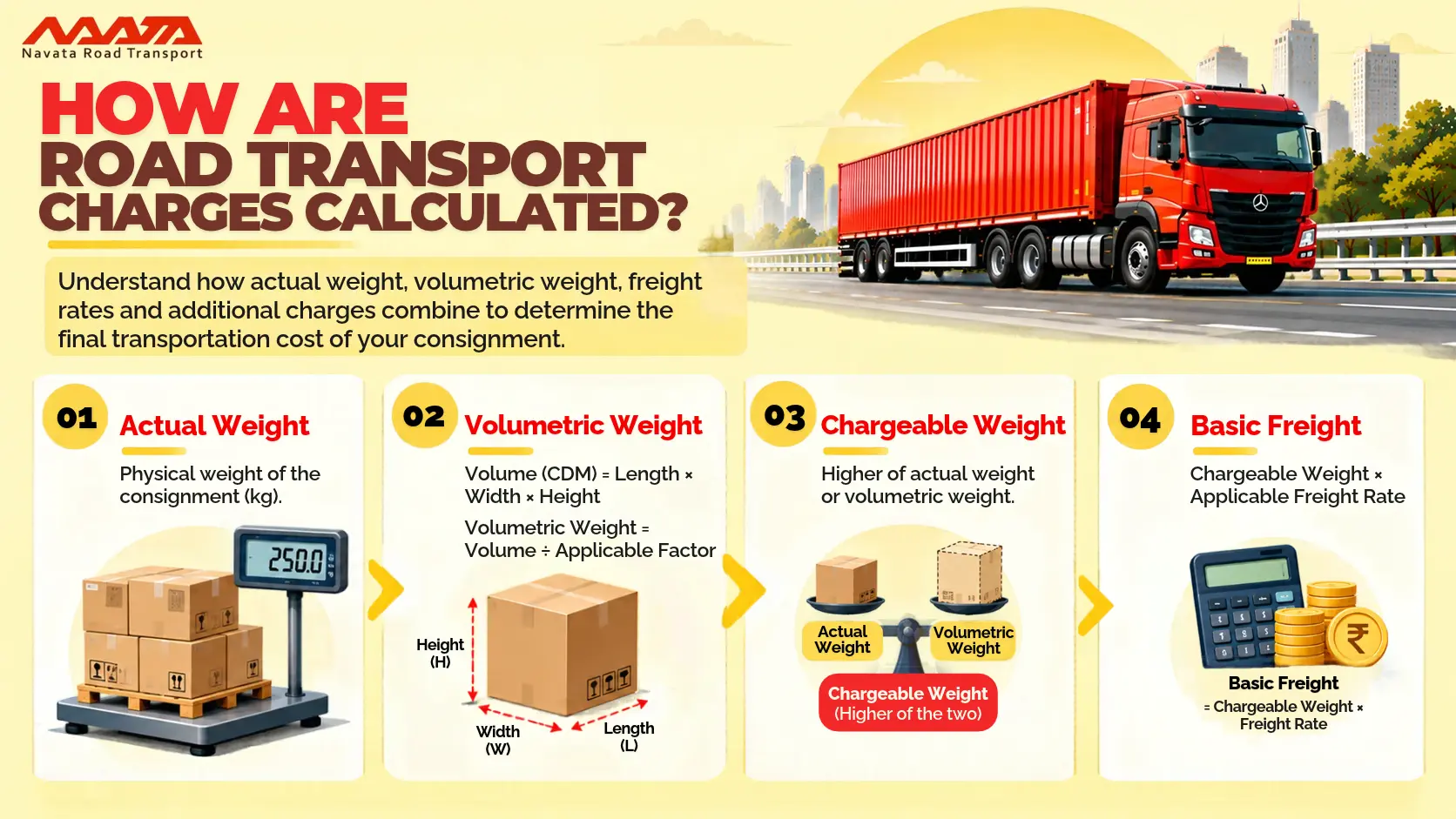
Transport charges per kg are the freight a road transporter bills for a part-load consignment, worked out on its chargeable weight: the higher of what the goods actually weigh and what their volume converts to under the transporter’s volumetric rule. In India that volumetric rule is stated in cubic decimetres (CDM) by some transporters and in cubic feet (CFT) by others, the rate also depends on the lane, the goods and the service, and a set of add-on charges (door delivery, handling, demurrage) and GST sit on top of the freight. This article explains how transport charges are calculated under the four pricing bases transporters use, how volumetric weight is converted to kilograms with a worked example, how part load transport charges differ from a full truck load priced per km, which extra charges to expect, and what to give a transporter to get an accurate quote. It describes the method, not a rate card: rates are quoted per consignment and change with fuel, season and route.
How Transport Charges Are Calculated: Four Pricing Bases
Road freight in India is not priced one way. The same 300 kg consignment can be billed per kg by a part-load transporter, per cubic foot by another, by the box by a courier, or as a share of a whole truck. Knowing which basis a quote uses is the first step in reading it, because the bases are not interchangeable and a per-kg figure from one is not comparable with a per-km figure from another.
Transport Pricing Methods: Key Differences
| Pricing Basis | Typically Used For | What You Pay For | What to Check on the Quote |
|---|---|---|---|
| Per kg (Part Load) | Consignments that share a vehicle with other customers' goods, booked at a branch. | Chargeable weight (actual or volumetric, whichever is higher) multiplied by the lane rate per kg. | The volumetric factor, any minimum freight per consignment, and what the rate includes. |
| Per CFT or CDM (Volumetric) | Light, bulky part-load goods that fill space before they reach payload. | Volume converted to kg at the transporter's factor, or billed directly per cubic foot. | The factor (CDM to kg, or kg per CFT) and how packed dimensions are measured. |
| Per Truck or per km (Full Truck Load) | One consignor hiring the whole vehicle for a lane. | A lump sum for the lane, or distance multiplied by a per-km rate for the vehicle class, plus fixed add-ons. | Vehicle class and body type, return-load position, tolls, loading and unloading time included. |
| Per Parcel or Weight Slab (Courier) | Small parcels billed in weight slabs through an express network. | Slab rate by zone, plus fuel surcharge and service fees. | Zone premiums, fuel surcharge percentage, cash-on-delivery and remote-area fees. |
Two things are common to all four. First, the price is for a lane (origin to destination), not a flat national figure, so a rate quoted for Vijayawada to Hyderabad says nothing about Vijayawada to Pune. Second, the freight line is only part of the invoice. The sections below take each basis in turn, then the charges that are added to any of them.
Volumetric Weight: When Space Costs More Than Weight
A truck runs out of space before it runs out of payload when the goods are light and bulky: empty containers, foam, furniture, plastic mouldings, packaged consumer goods. A transporter cannot carry such goods at a per-kg rate set for dense cargo, so part-load billing uses chargeable weight: the higher of the actual weight and the volumetric weight. Navata Road Transport’s published FAQ states the rule plainly: freight is calculated on actual weight or volumetric weight (CDM), whichever is higher, with additional charges for special services such as door delivery, insurance or express delivery.
How CDM is converted to kg
CDM stands for cubic decimetre. One decimetre is 10 cm, so a cubic decimetre is a 10 cm by 10 cm by 10 cm block (one litre of space), and a cubic metre holds 1,000 of them. Multiplying a consignment’s length, width and height in decimetres gives its volume in CDM; the transporter then applies a conversion factor to turn that volume into kilograms. Navata’s FAQ gives its own factors: for Andhra Pradesh, 2 CDM equals 1 kg, so length by width by height in decimetres divided by 2 is the chargeable weight; for Tamil Nadu, Karnataka and Pondicherry, the CDM figure is divided by 2.5. Those factors are Navata’s published terms at the time of writing and are the kind of detail that differs between transporters and states, so always read them off the quote you are given.
Worked Example: Calculating Chargeable Weight for a Packed Carton
| Step | Figure |
|---|---|
| Packed Carton, Measured After Packing | 100 cm long, 60 cm wide, 50 cm high; actual weight 90 kg. |
| Convert to Decimetres | 10 dm by 6 dm by 5 dm. |
| Volume in CDM | 10 × 6 × 5 = 300 CDM (0.3 cubic metre). |
| Volumetric Weight, Andhra Pradesh Factor (2 CDM = 1 kg) | 300 / 2 = 150 kg. |
| Volumetric Weight, Tamil Nadu, Karnataka or Pondicherry Factor (CDM / 2.5) | 300 / 2.5 = 120 kg. |
| Chargeable Weight (Higher of Actual and Volumetric) | 150 kg on the Andhra Pradesh factor; 120 kg on the 2.5 factor; the 90 kg actual weight is not billed. |
| Freight | Chargeable weight multiplied by the per-kg rate for the lane, before add-on charges and GST. |
The same logic appears in other units. Many Indian part-load transporters quote in cubic feet (CFT), with one cubic metre equal to about 35.31 CFT, and bill per CFT or per kg, whichever comes to more. One international freight calculator’s guide cites a European road convention of 333 kg per cubic metre and the IATA air convention of 167 kg per cubic metre; the conversion below shows how the Navata factors compare.
Volumetric Weight Conventions Across Different Transport Modes
| Convention | Stated As | Chargeable Weight of a One Cubic Metre Consignment | Source |
|---|---|---|---|
| Navata Road Transport, Andhra Pradesh | 2 CDM = 1 kg | 500 kg | Navata FAQ, read 28 October 2026 |
| Navata Road Transport, Tamil Nadu, Karnataka, Pondicherry | CDM divided by 2.5 | 400 kg | Navata FAQ, read 28 October 2026 |
| Indian Part-Load Quoting in Cubic Feet | 1 cubic metre = about 35.31 CFT; billed per CFT or per kg, whichever is higher | Depends on the transporter's per-CFT rate | Industry reference chart (containermath.com) |
| European Road Freight Convention (One Calculator's Guide) | 333 kg per cubic metre (the source notes regional standards vary) | 333 kg | cbmcalculator.com, 2025 |
| Air Freight (IATA Convention) | 167 kg per cubic metre | 167 kg | cbmcalculator.com, 2025 |
Measure the consignment as packed for travel, including pallet, crate or protruding parts, because the transporter may re-measure. Navata’s booking terms reserve the right of re-measurement, re-weighment and re-classification of rates at the destination, with any amount omitted or undercharged collected before delivery. Measuring and declaring accurately at booking avoids that correction. For cargo that exceeds standard truck dimensions, see what counts as over dimensional cargo, which is priced on a different basis again.
Part Load Transport Charges vs Full Truck Load
Part load transport charges are per-kg or per-CFT rates for consignments that share a vehicle with other customers’ goods, moving through the transporter’s branches and hubs. A full truck load (FTL) is a whole vehicle hired for one consignor, usually priced as a lump sum for the lane or as a rate per km. The two are explained in detail in LTL vs FTL; here the question is only what each does to the price per kilogram. Some transporters and LTL services also apply a minimum chargeable weight or minimum freight per consignment (one courier aggregator’s guide cites a 10 kg minimum on a business LTL service), so ask whether one applies to your lane.
Part Load vs Full Truck Load: Key Differences
| Factor | Part Load (Per kg or Per CFT) | Full Truck Load (Per Truck or Per km) |
|---|---|---|
| Unit of Pricing | Chargeable weight of your consignment. | The vehicle, for the lane. |
| Handling in Transit | Loaded at the booking branch, moved through hubs, delivered from the destination branch. | Loaded once, moved point to point, unloaded once. |
| What Lowers the Price per kg | Dense consignments that are billed on actual weight; main lanes; booking-branch discounts. | Filling the vehicle's volume and payload; lanes with a return load. |
| What Raises It | Light or bulky goods (volumetric billing), fragile or special goods, off-route destinations. | Larger vehicle than the load needs, empty return, long detention. |
| Who It Suits | Small and medium consignments, multiple destinations. | Large consignments to a single point, or goods that should not be handled in transit. |
| Discounts | Navata: special discounts available for part loads through the nearest branch. | Navata: special discounts available for full loads; separate vehicle allocation for single-point delivery. |
The per-kg rate on a part load reflects the handling it carries: loading at the booking branch, transshipment at one or more hubs, sorting and delivery at the destination branch. It rises for light or bulky goods (volumetric billing), for goods that need special handling and for destinations off the transporter’s main lanes; ask the branch how the rate changes with weight on your lane. Navata’s FAQ notes that special discounts are available for both part loads and full loads through the nearest branch, so published or indicative rates are a starting point, not the final figure.
There is a crossover. Once a consignment occupies most of a vehicle’s volume or payload, the full truck’s lump-sum price divided by the weight carried can be lower per kg than the part-load rate, and the goods travel without intermediate handling. One Indian transporter’s published guide illustrates the arithmetic: a truck costing about Rs 7,600 for a run carrying 3,000 kg works out to roughly Rs 2.53 per kg. Navata’s FAQ notes that separate vehicle allocation is provided for full load transportation, when delivery is to a single point. Whether to book a full truck load or stay on part load is therefore a volume question first and a rate question second.
Courier per-kg pricing is a different market. Express courier networks quote surface rates in small weight slabs with zone and remote-area premiums; one courier aggregator’s 2026 guide puts base surface rates for a 1 kg parcel at roughly Rs 60 to Rs 120 per kg before surcharges, and cites a business LTL service at Rs 6 to Rs 10 per kg with a 10 kg minimum. Those figures describe the courier segment, not transporter part-load rates, but they show why a small-parcel per-kg price should never be compared with a transporter’s per-kg rate for a 500 kg consignment.
Truck Transport Charges per km for a Full Truck Load
For a full truck load the unit is the vehicle, and transporters build the price from distance, vehicle class and return-load prospects. Truck transport charges per km are quoted higher for larger vehicles and lower per tonne-kilometre, because a 32 ft multi-axle truck spreads its fuel, driver, toll and depreciation over far more payload than a 14 ft truck.
No official published rate table for truck transport charges in India was found. The ranges below are one Indian transporter's indicative figures for its own services (guide published February 2025, revised May 2026), shown to illustrate the spread between vehicle classes. The same guide elsewhere quotes a 20-ton full truck at Rs 50 to Rs 100 per km, which its own table does not match; the figures below are the table's. They are not Navata Road Transport rates and are not a quote.
Truck Types, Load Capacity and Approximate Transportation Rates per km
| Vehicle Class (As the Source Lists It) | Capacity (As the Source Lists It) | Approximate Rate per km (Source Range) |
|---|---|---|
| Mini Truck (Pickup) | 500 kg to 2 ton | Rs 10 to Rs 18 |
| Tata Ace / Small Truck | 0.5 to 1.5 ton | Rs 12 to Rs 20 |
| LCV | 1 to 5 ton | Rs 15 to Rs 25 |
| 6-Wheeler | 9 to 11 ton | Rs 20 to Rs 30 |
| 10-Wheeler | 16 to 20 ton | Rs 25 to Rs 40 |
| Multi-Axle | 25 to 40 ton | Rs 35 to Rs 55 |
| Container | 20 to 40 ft | Rs 50 to Rs 80 |
You Might Also Like To Read: Top 10 Advantages and Disadvantages of Road Transport in India
Several factors move a per-km quote on the same lane: diesel price, tolls, whether the lane offers the operator a return load or sends the truck back empty, road and terrain conditions, seasonal demand around festivals and the monsoon, the body type required (containerized or open body), and the type of goods. A broader discussion of what drives transport cost is in understanding transportation costs. To express a truck quote per kg, divide the total (freight plus the fixed add-ons below) by the weight you will actually load, and remember that an under-filled truck raises that figure quickly.
Charges That Sit on Top of the Freight
The freight line covers movement between the transporter’s booking point and destination point. Everything that happens before, around or after that movement can carry its own charge. Navata’s published FAQ and booking terms set out the pattern, and the stages below show where each charge arises.
- 1
Booking Packed dimensions and actual weight are declared; the chargeable weight is fixed; the lorry receipt is issued, with-pass if chosen.
- 2
Freight Chargeable weight multiplied by the lane rate; door pickup, loading and insurance are added where taken.
- 3
Transit Part loads move through branches and hubs; a full truck moves direct. GST applies on the freight at 5% or 18%.
- 4
Arrival The consignee is informed; the original consignee copy is needed; the transporter may re-measure or re-weigh; Navata allows 15 days of free storage.
- 5
Delivery At the destination office, or door delivery for a locally set charge; demurrage per day after the free period.
Door Delivery and Pickup
Under Navata’s terms, goods are delivered at the destination office; door delivery is available as a service and its charge depends on local market conditions at the destination branch. Ask the same question about pickup at origin. A quote that is ‘godown to godown’ and one that is ‘door to door’ are not the same price.
Handling, Loading and Unloading
Loading at origin and unloading at destination may be included, charged separately or left to the consignor and consignee, depending on the transporter and the goods. One transporter’s published guide puts typical loading and unloading charges in the range of Rs 500 to Rs 2,000 per truck for full loads; for a part load, ask whether handling is inside the per-kg rate or listed as a separate charge. Ask which applies before comparing quotes.
Demurrage and Free Storage
Consignments that are not collected after arrival occupy the transporter’s godown. Navata’s FAQ, as published at the time of writing (October 2026), allows 15 days of free storage from the date the consignment reaches the destination; after that, demurrage is charged per day by weight slab: Rs 1.75 for 1 to 25 kg, Rs 3.50 for 26 to 50 kg, Rs 5.25 for 51 to 75 kg and Rs 7.00 for 76 kg and above. The related charge on a hired truck, for holding the vehicle beyond the agreed loading or unloading time, is explained in detention fee in trucking.
Documents, Passes and Insurance
Delivery is made against the original consignee copy of the lorry receipt; Navata’s ‘with-pass’ facility sends that copy along with the consignment so the consignee can collect on arrival without waiting for the post. If the copy is lost, Navata’s FAQ provides for delivery against an indemnity bond on stamp paper. Navata’s booking terms also state that goods are carried at owner’s risk and that the firm is not liable for loss or damage in transit, which is why transit insurance is offered as an optional charge. How consignment documents work is covered in e-documentation in transportation.
GST on the freight
Freight from a goods transport agency carries GST. Following the 56th GST Council meeting, from 22 September 2025 a GTA’s transportation of goods is taxed at 5% with no input tax credit, or, at the GTA’s option, 18% with full input tax credit. Whether the transporter or the recipient pays depends on the forward-charge or reverse-charge position, which is explained in GST on transportation of goods. A per-kg quote may be stated before GST, so confirm.
How to Get an Accurate Quote
Transport charges per kg are re-adjusted at the destination when the booking information was incomplete. Give the transporter the following and the quote is far less likely to change at delivery:
- Packed dimensions and actual weight of every package, measured after packing, so the chargeable weight is settled before the truck is loaded, not re-measured at the destination.
- Nature of goods: fragile, liquid, hazardous, perishable, high value, or over dimensional, each of which can change the rate or the vehicle.
- Origin and destination points, and whether you need door pickup, door delivery, or godown-to-godown movement.
- Number of packages and packing type (cartons, bags, crates, pallets, loose), because packing drives both handling and volume.
- Service expectations: transit time needed, with-pass or standard documents, insurance required or owner’s risk accepted.
- Your GST registration status, which decides whether GST is charged forward or paid by you under reverse charge.
- The tax position of the quote: ask whether the figure is before or after GST and whether handling and door delivery are included.
For a Navata consignment, the Freight Calculator gives an estimate from the shipment details, and the nearest branch confirms door delivery charges, discounts and the volumetric factor that applies on your lane.
Measure, Declare, Then Compare
Transport charges per kg are predictable once the basis is clear: the chargeable weight (actual or volumetric, whichever is higher) sets the freight, the lane and the goods set the rate, and door delivery, handling, demurrage, insurance and GST are added according to the transporter’s published terms. Measure the packed consignment, declare it accurately, ask which basis and which inclusions the quote uses, and compare quotes only on the same terms.
Navata Road Transport moves part load and full truck load consignments across its branch network. Enter the shipment details in the freight calculator for an estimate, and confirm door delivery, discounts and the volumetric factor with the nearest branch.
Calculate Your FreightFAQs
How are transport charges calculated per kg?
The transporter works out the chargeable weight of the consignment, the higher of its actual weight and its volumetric weight, and multiplies it by the per-kg rate for the lane and type of goods. Add-on charges such as door delivery, handling or insurance, and GST, are added to that freight.
What is volumetric weight and why am I charged for it?
Volumetric weight converts the space a consignment occupies into an equivalent weight. A truck fills up on volume before it reaches its payload when goods are light and bulky, so transporters bill the higher of actual and volumetric weight. Navata's FAQ states 2 CDM = 1 kg for Andhra Pradesh and a divisor of 2.5 for Tamil Nadu, Karnataka and Pondicherry; other transporters publish their own factors, often in CFT.
What is CDM in transport?
CDM is a cubic decimetre, a 10 cm by 10 cm by 10 cm unit of volume (one litre). Length, width and height in decimetres multiplied together give a consignment's volume in CDM, which the transporter converts to kilograms with its published factor.
Is a full truck cheaper per kg than part load?
It can be, once the consignment fills most of the vehicle: the truck's lump-sum price divided by the weight loaded can come to less per kg than the part-load rate, and the goods avoid hub handling. For a small or medium consignment the part-load rate is the one to compare, because you pay only for the space and weight you use.
What extra charges apply besides the freight?
Depending on the transporter and service: door pickup or delivery, loading and unloading, demurrage after the free storage period, insurance where goods are otherwise carried at owner's risk, and GST. Navata's FAQ, for example, gives 15 days of free storage and then a per-day demurrage charge by weight slab.
How much GST is charged on transport charges?
Either 5% without input tax credit or, where the goods transport agency has opted for it, 18% with full input tax credit, under the 56th GST Council decisions in force from 22 September 2025. Ask whether the quoted figure is before or after GST and whether it will be charged to you under reverse charge.
Why was my consignment re-weighed or re-measured at the destination?
Navata's booking terms reserve the right to re-weigh, re-measure and re-classify a consignment at the destination and to collect any undercharged amount before delivery; other providers' published guides likewise bill on the higher of actual and volumetric weight. Accurate packed dimensions and weight declared at booking avoid the correction.
Thanks for Reading:- Transport Charges per kg in India: How Road Freight Rates Are Calculated
You May Also Like to Read
Recent Posts