Key Features of Road Transportation: Characteristics, Importance & Advantages
Table of Contents
Features of Road Transportation
Road transport moves goods and people using trucks, vans, and other vehicles over a public or private road network. For businesses, it fills a role no other mode quite matches: a truck can pick up a shipment at a factory loading dock and set it down at a customer’s door, without switching vehicles in between.
Understanding the features of road transport helps shippers and logistics planners decide when road is the right mode. Road transportation has a handful of characteristics that consistently make it central to domestic and regional freight movement. Each one shapes a different part of how a shipment actually gets from origin to destination.
1. Flexibility and Route Accessibility
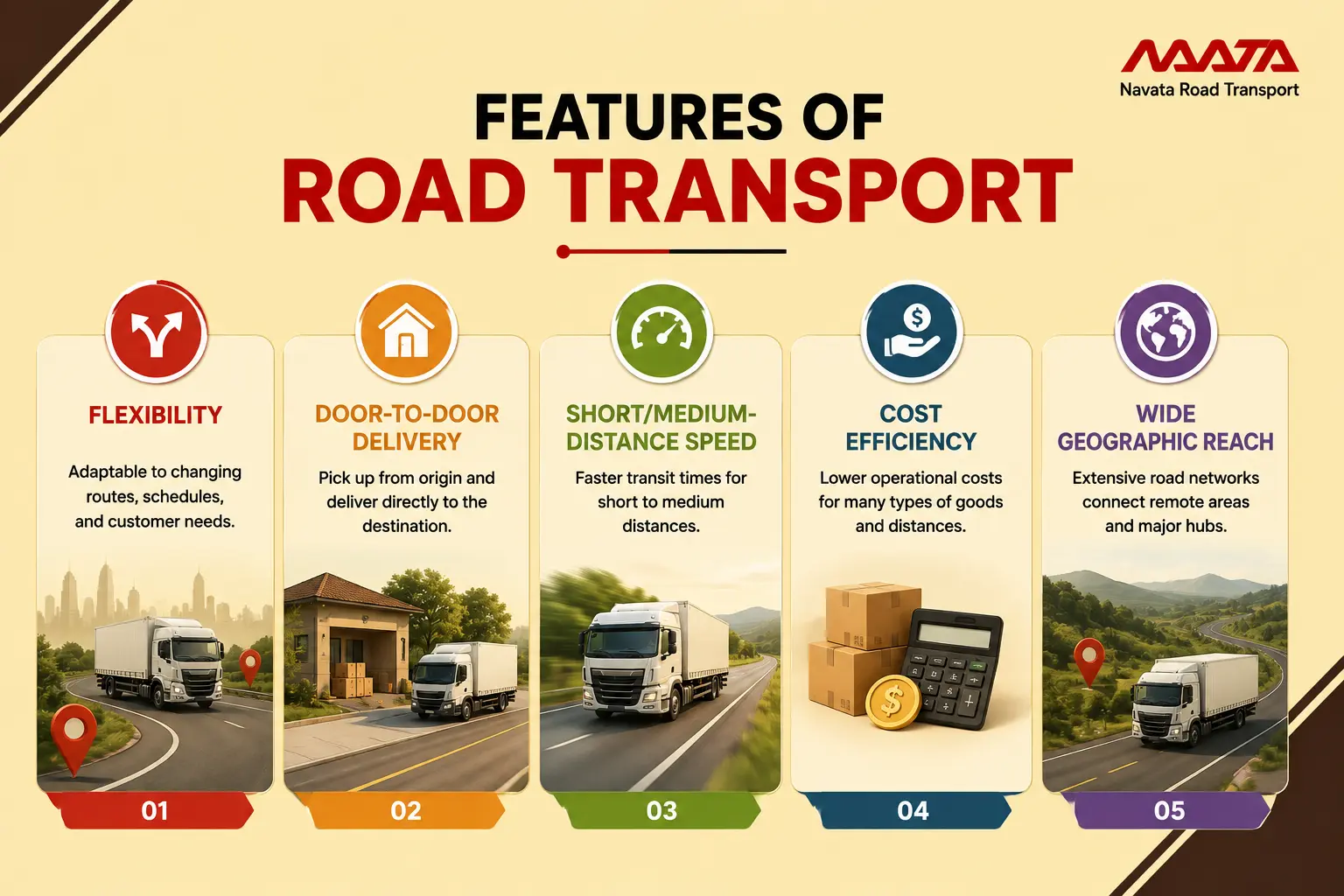
Unlike a train fixed to a track or a vessel fixed to a shipping lane, a truck can take any road that leads to the destination and change course when it needs to. If a route is closed, congested, or simply not the fastest option that day, a driver or dispatcher can reroute in real time.
This flexibility extends to scheduling too. A manufacturer whose production run finishes later than planned can usually still get a truck booked for pickup that day; that kind of last-minute adjustment is far harder to arrange with a scheduled rail slot or vessel booking. Road transport also reaches locations such as industrial parks, secondary towns, and rural distribution points that have no direct rail line, port, or airport nearby.
2. Door-to-Door Delivery
Road transport can move a shipment directly from pickup point to final destination, without an intermediate terminal transfer. That matters operationally: every extra handoff between modes adds handling time, paperwork, and a chance for damage or delay.
This is also why road plays such a large role in first-mile and last-mile logistics. Cargo that arrives by sea or air still has to complete its journey by road to reach a warehouse, store, or customer. For shippers, fewer touchpoints mean tighter control over the shipment; for customers, it means a more predictable delivery window.
3. Speed for Short and Medium Distances
Road transport tends to be time-efficient for shipments moving within a region or between neighboring markets, largely because there’s less handling involved than in a multimodal journey no transfer to a rail yard or port terminal along the way.
That said, road transport isn’t always the fastest mode in absolute terms air freight will usually beat it over long distances, and its actual speed depends heavily on traffic conditions, road quality, weather, and regulatory checkpoints along the route. The advantage is less about outright speed and more about minimizing the delays that come from switching between modes.
4. Cost Efficiency
For many short and medium-distance shipments, road transport is a practical, economical choice: there’s no need for specialized rail wagons, port handling charges, or an air cargo premium, and direct delivery reduces the handling costs that come with extra transfers.
Actual cost depends on fuel prices, distance, vehicle type, and how well a shipment is consolidated a full truckload (FTL) spreads cost differently than a less-than-truckload (LTL) booking. Road isn’t automatically the cheapest option in every case; for very large volumes moving long distances, rail or water transport often costs less per unit of cargo.
5. Wide Geographic Reach
Road networks connect cities, towns, industrial areas, warehouses, distribution centers, and retail locations, including many places that other transport infrastructure simply doesn’t reach. That density is what makes road transport the connective layer in multimodal logistics: cargo arriving at a port, rail yard, or airport almost always completes its journey by road.
You Might Also Like To Read: Top 10 Advantages and Disadvantages of Road Transport in India
Characteristics of Road Transportation
Road transportation has several characteristics that make it an important part of freight and supply chain operations. Its accessibility, flexibility, direct connectivity, and ability to handle different types of cargo make it suitable for both local and long-distance movement.
1. High Accessibility
Road transport can reach cities, towns, industrial areas, warehouses, and remote locations that may not have direct access to railways, ports, or airports. This wide network makes road transportation highly accessible for businesses and customers.
2. Flexible Scheduling
Road transportation offers greater flexibility in departure times and delivery schedules. Trucks can be scheduled according to shipment requirements, making it easier to respond to urgent orders, changing demand, and delivery time constraints.
3. Direct Connectivity
One of the key characteristics of road transportation is its ability to provide direct connectivity between the pickup and delivery points. This reduces the need for multiple transfers and can simplify the movement of goods.
4. Easy Loading and Unloading
Goods can generally be loaded and unloaded at warehouses, factories, distribution centres, and customer locations. This makes road transport practical for shipments that require frequent handling or direct delivery.
5. Suitable for Different Cargo Types
Road vehicles are available in different sizes and configurations, allowing them to transport a wide range of goods. Depending on the vehicle and equipment used, road transport can handle general cargo, packaged goods, machinery, agricultural products, and other freight.
6. Supports First-Mile and Last-Mile Delivery
Road transportation plays an important role in connecting different stages of the supply chain. It can move goods from manufacturers or suppliers to warehouses and distribution centres during the first mile and deliver shipments from distribution points to the final customer during the last mile.
Importance of Road Transport in Logistics
Road transport is what physically connects the stages of a supply chain: manufacturers to warehouses, warehouses to distributors, distributors to retailers, and retailers to customers. Rail, water, and air can carry the bulk of a long-haul journey, but road transport is almost always what completes it at both ends.
- First-mile transportation: Moving raw materials or finished goods from a supplier or factory to the next stage in the supply chain.
- Middle-mile transportation: Transferring goods between warehouses, distribution centres, hubs, or other intermediate locations within the supply chain.
- Last-mile transportation: Delivering goods from a distribution centre or retail location to the final customer, especially important for e-commerce.
- Mode-to-mode connectivity: Moving cargo between road networks and ports, rail yards, or airports to enable efficient multimodal transportation.
- Reach into underserved areas: Connecting locations without direct rail, port, or airport access, helping maintain reliable supply chains and the availability of goods.
This is why the importance of road transport in logistics goes beyond any single leg of a journey it’s the mode that keeps the rest of the supply chain connected and functional.
Advantages of Road Transport
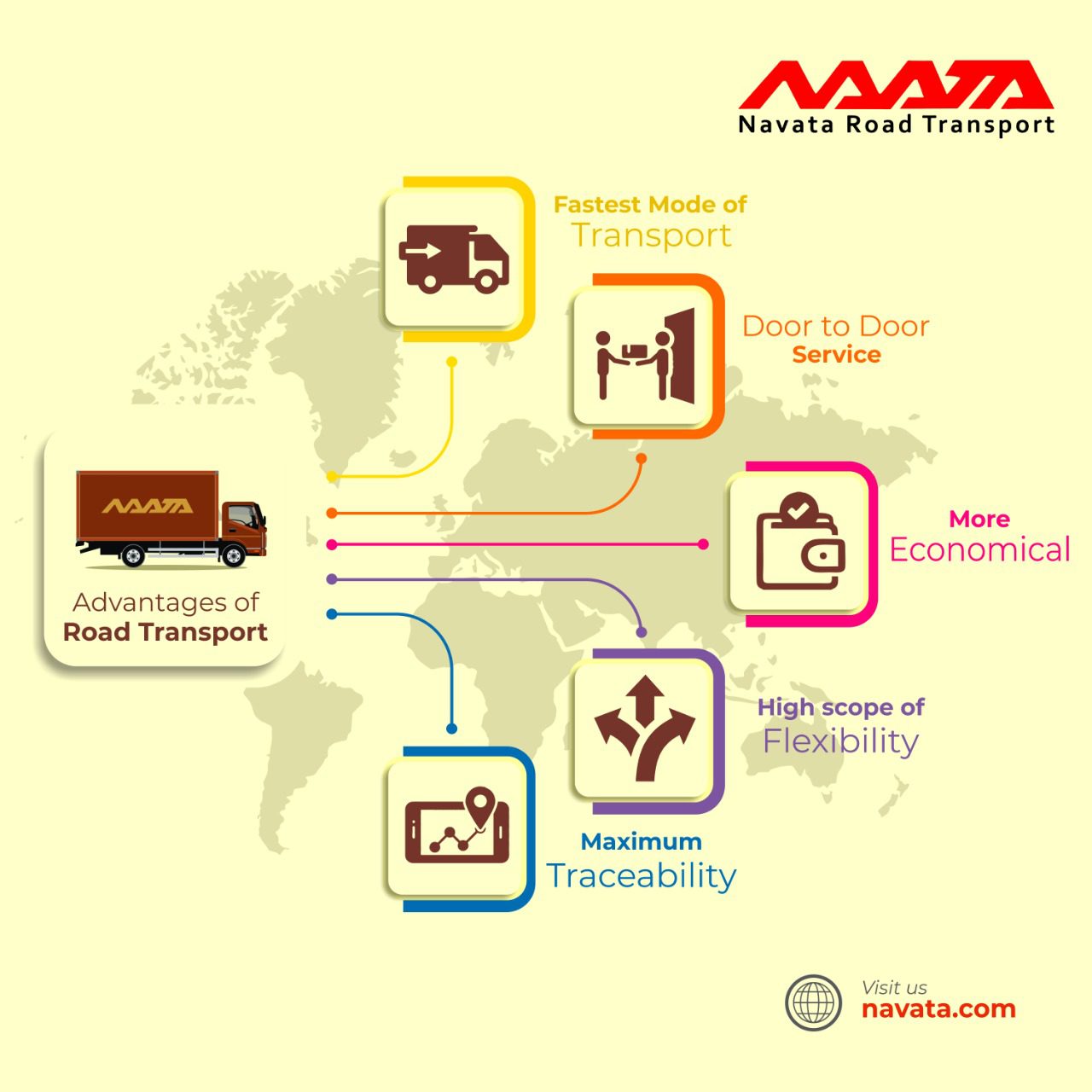
The advantages of road transport largely follow from the features already covered: flexibility in routing and scheduling, true door-to-door delivery, broad accessibility, faster movement over short distances, and easier day-to-day scheduling than modes that run on fixed timetables.
This section is intentionally brief for a full breakdown of the trade-offs, including where road transport falls short compared with other modes, see Navata’s dedicated guide to the advantages and disadvantages of road transport.
Road Transport vs Other Modes
No single mode of transport is the best for every shipment. The right choice depends on factors such as distance, cargo type, delivery urgency, and available infrastructure. Road transport generally offers greater flexibility and door-to-door connectivity, while rail, air, and water transport have their own advantages for specific requirements.
Road Transport
Road transport is particularly suitable for short and medium-distance shipments because it can provide direct connectivity between suppliers, warehouses, businesses, and customers. It also offers high flexibility in scheduling and can reach locations that may not have direct access to railways, ports, or airports.
Rail Transport
Rail transport is generally better suited for moving heavy and bulk cargo over long distances, where high capacity and cost efficiency are important. However, its fixed routes can limit flexibility and door-to-door connectivity compared with road transport.
Air Transport
Air transport is the preferred option when speed and urgency are the main priorities. It can move goods quickly over long distances, but its higher cost makes it less suitable for shipments where transportation cost is the primary concern.
Water Transport
Water transport is generally suitable for large volumes of heavy or bulk cargo, particularly over long distances. While it can offer cost advantages, it usually has lower speed and requires access to ports or waterways.
Overall, road transport tends to have the edge when shipments require door-to-door delivery, flexible scheduling, short or medium-distance movement, or access to locations outside major transport networks. The most suitable mode ultimately depends on the specific requirements of each shipment.
When Is Road Transport the Best Choice?
Road transport is often the most practical choice when a shipment requires flexibility, direct connectivity, and reliable access to the final destination. It is particularly effective in the following situations:
- Short-distance shipments: Ideal for moving goods within a city, state, or nearby region where direct road connectivity can reduce handling and transfer time.
- Medium-distance domestic or cross-border shipments: Suitable for regional and domestic freight, especially when rail or water infrastructure is limited or unavailable.
- Door-to-door delivery: A strong option when goods need to move directly from a supplier, factory, or warehouse to the customer’s location without multiple transfers.
- Time-sensitive regional deliveries: Useful when avoiding transfer and handling delays is more important than achieving the absolute fastest possible transit time.
- Locations outside major transport networks: Road vehicles can reach destinations without direct access to railways, ports, or airports.
- First-mile and last-mile movement: Road transport connects suppliers, factories, warehouses, distribution centres, and final customers as part of longer multimodal journeys.
- Flexible pickup and delivery requirements: Suitable for shipments that require adaptable pickup times, delivery windows, or changes in routing.
For example, a retailer requiring next-day regional delivery for an e-commerce order may rely on road transport for its flexibility and direct delivery capability. Similarly, a manufacturer located outside the rail network may use trucks to move goods to nearby warehouses, distribution centres, or customers.
Conclusion
The features of road transport flexibility, door-to-door delivery, accessibility, short-to-medium distance speed, and cost efficiency explain why it remains the connective layer of most supply chains, even as rail, air, and water each dominate their own niches.
The practical takeaway: road transport earns its place in a logistics plan because of reach and control, not because it wins on every metric. When evaluating a shipment, match the mode to the distance, cargo type, and urgency involved, and treat road transport as the mode that keeps the rest of the chain connected at both ends.
Thanks For Reading: 5 Key Features of Road Transportation
Recent Posts