LR Copy Meaning: What a Lorry Receipt Is and Why It Matters
Table of Contents
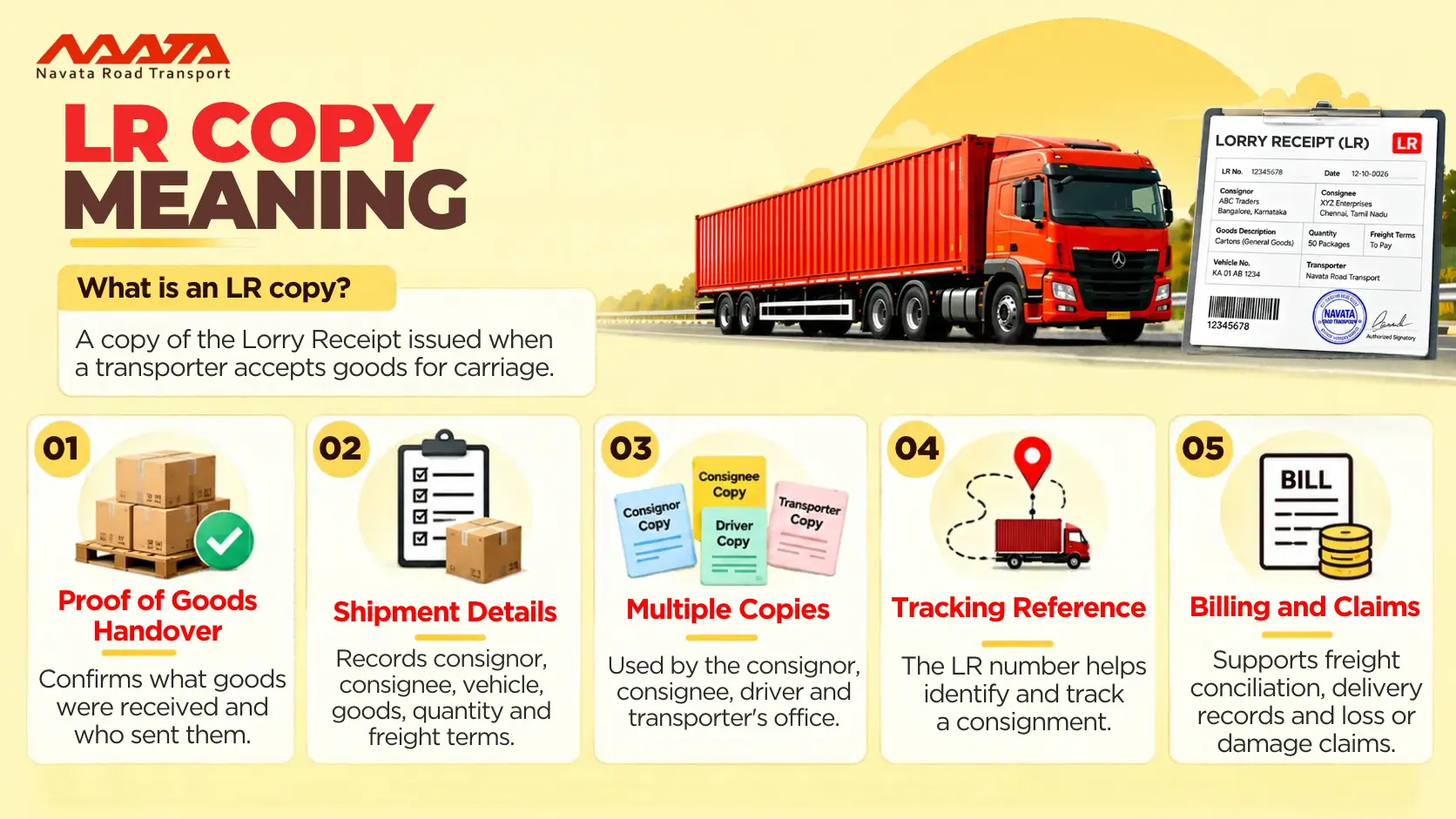
An LR copy is a copy of the lorry receipt, the document a road transporter issues when it accepts goods for carriage. It confirms what was handed over, by whom, to whom it is going, on which vehicle and on what terms. The consignor, the consignee and the transporter each keep a copy, and the same document is used later for tracking, freight billing, delivery and any claim for loss or damage.
This guide covers the LR copy full form and its other names, what a lorry receipt contains, who keeps each copy, what the LR number is used for, how the LR connects to GST and the e-way bill, what Indian law says about it, and the checks that prevent most LR disputes.
LR copy full form and meaning
The LR copy full form is Lorry Receipt copy. LR stands for Lorry Receipt, and “copy” refers to one of the duplicate sheets the transporter prints when it books the consignment. In everyday use, “LR copy” usually means the copy a shipper or consignee is holding.
The same document goes by several names in Indian road freight:
- Lorry receipt (LR), the most common term with transporters and in logistics teams.
- Goods receipt (GR), the term the Carriage by Road Act, 2007 uses.
- Consignment note, the term used under GST.
- Bilty, a colloquial name used by traders in many markets.
Whatever it is called, the function is the same. The LR is the transporter’s written acknowledgement that it has received the goods and accepted responsibility for carrying them to the named consignee.
What a lorry receipt contains
Layouts differ from one transporter to another, but a complete lorry receipt carries the same core details:
- LR number, printed or system-generated, and the booking date
- Booking branch and destination branch, or origin and destination places
- Consignor name, address and GSTIN
- Consignee name, address and GSTIN
- Registration number of the vehicle carrying the goods
- Description of goods, number of packages and type of packing
- Actual weight and charged weight
- Declared value of the goods
- Invoice number and date, and the e-way bill number where one is required
- Freight amount and payment basis (paid, to-pay or billed to the customer’s account)
- Who is liable to pay GST on the freight
- Risk basis, where the transporter marks one (owner’s risk or carrier’s risk)
- Signatures or stamps of the booking clerk and the consignor
The terms and conditions printed on the back of the LR matter as much as the front. They usually cover the transporter’s liability limits, the time allowed for claims, demurrage on goods not collected, and the transporter’s right to hold goods until freight is paid. Read them once for every new transporter you use.
Who keeps each LR copy
The Carriage by Road Act, 2007 requires a common carrier to issue the goods receipt in triplicate, with the original going to the consignor. In practice, most transporters print three or four copies. A common split looks like this:
| Copy | Who Holds It | What It Is Used For |
|---|---|---|
| Consignor Copy | The sender | Proof of booking, freight billing, and the basis for any claim |
| Consignee Copy | Travels with the goods and is handed over at delivery | Lets the consignee check the consignment and take delivery |
| Driver or Lorry Copy | The driver, during transit | Shown at checkpoints with the invoice and e-way bill |
| Office Copy | The booking branch | The transporter's own record for accounts, tracking and audits |
At delivery, the consignee signs and stamps the delivery copy. That signed copy is the proof of delivery the transporter uses to close the consignment and raise or settle the freight bill. Many transporters now capture this step digitally as an electronic proof of delivery instead of a signed paper sheet.
-
01Booking The consignor hands over the goods with a goods forwarding note declaring their value.
-
02LR Issued The transporter accepts the goods and issues the LR. The consignor keeps the original.
-
03In Transit The driver carries the lorry copy with the invoice and e-way bill. The LR number links them.
-
04Delivery The consignee copy travels with the goods. Count and inspect the shipment before signing.
-
05Proof of Delivery The delivery copy is signed and stamped, or captured as an ePOD. Note any damage before acknowledging receipt.
-
06Close and Bill The office copy and signed delivery record support consignment closure and freight billing.
What the LR number is used for
The LR number is the reference that ties every later step back to one consignment. It is used for:
- Tracking. Transporters locate a consignment in their system by its LR number. Navata’s website has a Track option in its main header, so keep your LR to hand when you check a shipment on navata.com.
- The e-way bill. The e-way bill form (GST EWB-01) has a field for the transport document number, and the form’s notes list the goods receipt number as one such document. Entering the LR number links the e-way bill to the physical consignment.
- Freight billing. Invoices and payment reconciliation are matched line by line against LR numbers.
- Claims and disputes. Any notice of shortage, damage or delay should quote the LR number, the booking date and the number of packages.
Freight payment terms on an LR
The payment basis is printed on the LR and decides who pays the transporter and when. Three terms are standard in Indian road freight:
- Paid. The consignor pays the freight at booking.
- To-pay. The consignee pays the freight when taking delivery. The transporter will normally release the goods only after payment.
- To be billed (TBB). The freight is billed later to a customer who has a credit arrangement with the transporter, on the agreed billing cycle.
A wrong payment basis is one of the most common reasons a delivery is held at the destination branch. If the consignee does not expect to pay, the goods wait while the two parties sort it out.
The LR as a consignment note under GST
Under GST, a goods transport agency (GTA) is defined as a person who provides a service in relation to transport of goods by road and issues a consignment note, by whatever name called. Issuing a consignment note is the essential condition for being treated as a GTA, which is why the LR decides how GST on freight is handled.
The particulars a consignment note must carry come from Rule 4B of the Service Tax Rules, 1994, which GST practice still follows: a serial number, the names of the consignor and consignee, the registration number of the goods carriage, details of the goods, the origin and destination, and the person liable to pay the tax. Rates and the choice between forward charge and reverse charge are covered in our guide to GST for goods transport agencies.
What Indian law says about the lorry receipt
The Carriage by Road Act, 2007 and the Carriage by Road Rules, 2011 govern common carriers by road. Both have been in force since 2011. The points that matter most to a shipper:
- Registration. A common carrier needs a certificate of registration to operate.
- Goods forwarding note. The consignor gives the carrier a goods forwarding note (Form 7) that declares the value of the goods and whether any of them are dangerous or hazardous.
- Goods receipt. The carrier issues the goods receipt (Form 8) on accepting the consignment. It is prima facie evidence of the weight or measure, the number of packages and the other particulars stated on it.
- Hazardous goods. For dangerous or hazardous goods, the forwarding note and goods receipt are printed with the upper left-hand corner in red.
- Liability limit. For total loss, the carrier’s liability is limited to ten times the freight paid or payable, and never more than the value declared in the forwarding note. The Act lets the parties agree a higher liability where the consignor pays a higher risk rate.
- Notice of loss or damage. Visible loss or damage should be noted in writing when the goods are handed over. Loss or damage that is not apparent must be notified in writing within six days of the goods being handed over.
- Time limit for a suit. No suit or other legal proceeding for loss or damage can be brought against the carrier unless written notice of the loss or damage was served within 180 days of the booking date.
Two practical consequences follow. The value declared on the forwarding note caps what you can recover for a total loss, along with the ten-times-freight limit, so declare it accurately and make sure it matches the LR. And a claim starts with a written note on the delivery copy, not with a phone call. The main claim types are explained in our note on freight claims.
Owner's risk and carrier's risk
Many LRs are stamped “owner’s risk” or “carrier’s risk”. Under owner’s risk, the consignor or consignee carries the risk of loss or damage in transit, normally backed by their own goods-in-transit insurance. Under carrier’s risk, the transporter accepts a higher level of liability, usually for an additional charge.
The exact meaning of each term is set by the conditions printed on that transporter’s LR and, for common carriers, by the statutory limits above. Check which basis applies before dispatch, and match your insurance cover to it.
LR vs invoice vs e-way bill vs bill of lading
Four documents often travel together and are easy to confuse. Each one answers a different question.
- Issued by
- Road transporter
- What it proves
- The goods were received for carriage on stated terms.
- Issued by
- Seller
- What it proves
- The sale or supply, its value and the tax charged.
- Issued by
- Supplier, recipient or transporter on the GST e-way bill portal.
- What it proves
- The movement of goods has been declared for GST purposes.
- Issued by
- Shipping line or its agent
- What it proves
- Receipt of goods for carriage by sea and, where applicable, title to the cargo.
Check consistency across the LR, invoice and e-way bill:
Consignor Consignee Goods Quantity ValueThe invoice, the e-way bill and the LR must agree on the consignor, consignee, goods, quantity and value. A mismatch between them can lead to the vehicle being stopped and the goods detained in transit. For more on the paperwork that moves with a truck and how it is going digital, read our note on e-documentation in transportation.
Common LR mistakes that cause delays and disputes
- Consignee name or GSTIN on the LR differs from the invoice or e-way bill.
- Package count on the LR does not match what was loaded, so any later shortage cannot be proved.
- Declared value left blank or set too low, which limits any claim.
- Wrong payment basis, so the consignee refuses a to-pay delivery.
- Vehicle number on the LR differs from the vehicle actually carrying the goods.
- Consignee signs a clean delivery copy without noting visible damage or shortage.
- LR copies are not kept, so there is nothing to quote when tracking or filing a claim.
LR checklist before dispatch and at delivery
Before dispatch, the consignor should confirm:
- Consignor and consignee details, including GSTIN, match the invoice.
- Description of goods, package count, and weight match what is being loaded.
- The declared value is filled in and matches the invoice.
- The e-way bill number is on the LR where one is required.
- The payment basis and the person liable for GST are correct.
- The risk basis is marked and your insurance matches it.
- Your copy is signed or stamped by the booking branch.
At delivery, the consignee should:
- Count the packages against the LR before signing.
- Inspect the packing for damage, tampering or wetness.
- Write any shortage or damage on the delivery copy, then sign.
- Send written notice within six days for damage found after opening the packages.
- Keep a copy of the signed delivery record with the LR number.
Booking your next consignment
A correct LR is the simplest protection a shipper has: it fixes what was sent, on what terms, and what can be claimed if something goes wrong. Navata Road Transport was established in 1982. Explore the transportation, warehousing and 3PL services on offer, or find your nearest Navata branch to book a consignment.
Frequently Asked Questions
What is the full form of LR in transport?
LR stands for Lorry Receipt. It is the receipt a road transporter issues when it accepts goods for carriage, and it is also called a goods receipt (GR), a consignment note or a bilty.
What does LR copy mean?
An LR copy is one of the copies of the lorry receipt. The transporter prints several copies so that the consignor, the consignee, the driver and the booking office each hold the same record of the consignment.
Is an LR the same as an e-way bill?
No. The LR is issued by the transporter and records the contract of carriage. The e-way bill is a GST declaration generated on the government portal. The LR number is entered on the e-way bill as the transport document number.
Is an LR the same as a consignment note?
In road transport, yes. Consignment note is the term used under GST, lorry receipt is the trade term and goods receipt is the term in the Carriage by Road Act, 2007.
What should I do if goods arrive damaged?
Record the damage in writing on the delivery copy of the LR before signing, photograph it, and give the transporter written notice quoting the LR number. Damage that is not visible at delivery must be notified in writing within six days of handover.
Can I track a shipment with the LR number?
Most transporters use the LR number as the tracking reference. Navata's website has a Track option in its main header for checking the status of a consignment.
Need to move goods by road?
Navata Road Transport has been delivering trust since 1982.
Information current as of October 2026. This article is general information, not legal or tax advice. Liability terms differ between transporters, so read the conditions printed on your LR and confirm statutory points against the current text of the Carriage by Road Act, 2007, the Carriage by Road Rules, 2011 and the applicable GST notifications.
Thank you for Reading This blog: LR Copy Meaning: What a Lorry Receipt Is and Why It Matters
Recent Posts