
Transit Time in Road Transport: How Long Truck Shipments Take in India and What Affects It
Table of Contents
Transit time in road transport is the time a consignment spends between pickup at the consignor’s premises and delivery at the consignee’s door, including every hub, halt and handover in between. For a truck shipment in India it is counted in days, and the number depends on distance, the type of load, how many times the goods are handled, driver hours, documentation and the season. This article explains what transit time includes, how it differs from lead time and delivery time, the factors affecting transit time on Indian roads, what indicative ranges look like, and how to reduce transit time on your own shipments.
What Is Transit Time in Road Transport?
Transit time is the elapsed time from pickup, or from the departure of the loaded vehicle depending on how the transporter counts it, to the moment the goods are delivered. On a full truck load the vehicle runs direct, so transit time is largely driving time plus rest halts. On a part load the consignment travels through one or more hubs, so transit time also includes unloading at a hub, sorting, waiting for the next outbound vehicle and loading again.
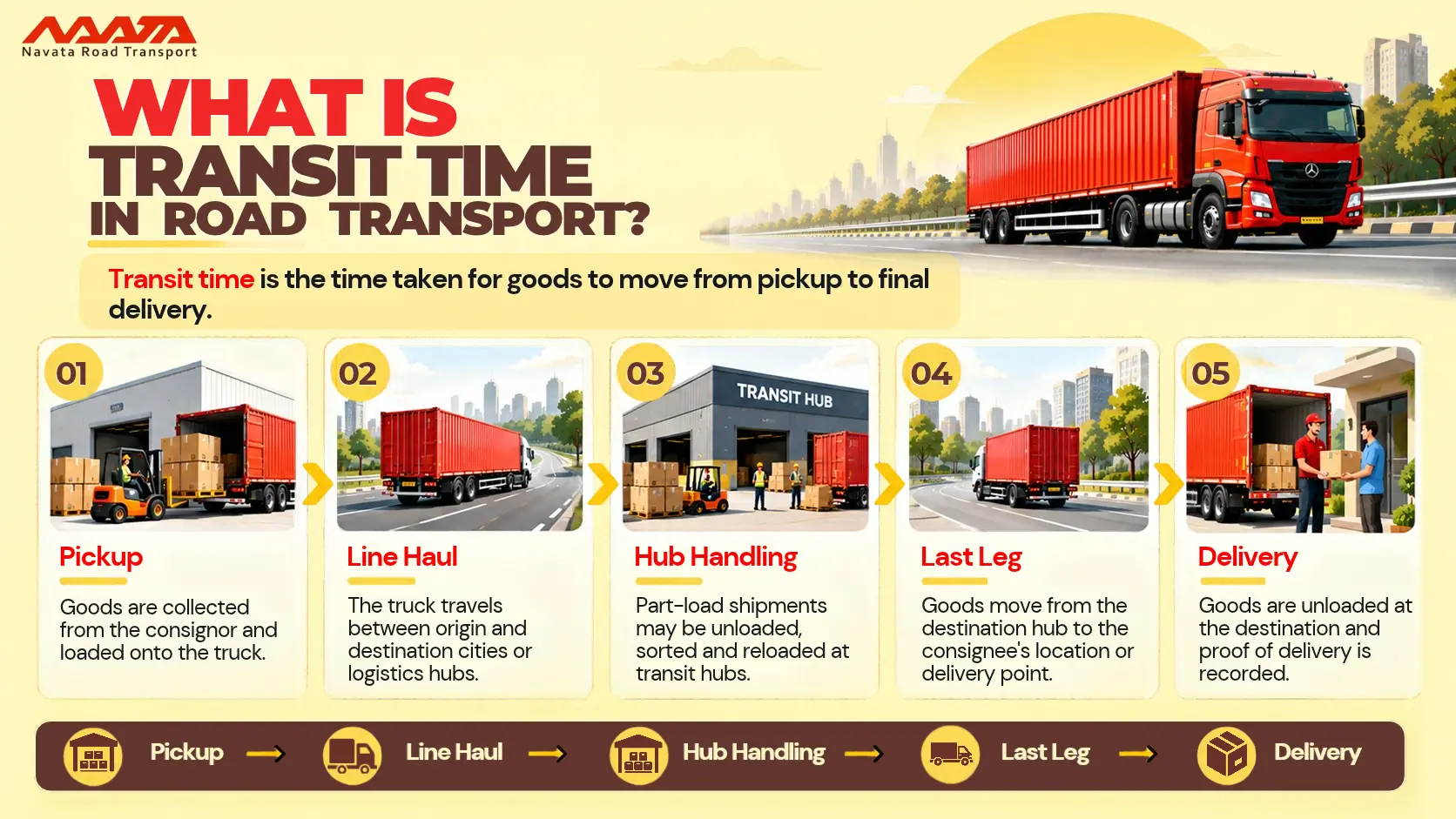
Transit time does not normally include the time you spend getting a quote, booking the vehicle or preparing documents before pickup. Those belong to lead time, which is why the two terms are often confused.
Transit Time vs Lead Time vs Delivery Time
The three terms describe three different clocks. Transit time vs lead time is the distinction most shippers need, because a transporter quotes the first while a customer judges the second.
Transit Time vs Lead Time vs Delivery Time
| Term | Starts when | Ends when | Who mostly controls it |
|---|---|---|---|
| Transit time | Pickup, or departure of the loaded vehicle, as the quote defines it. | The goods are delivered. | The transporter. |
| Lead time | The order or booking is placed. | The goods are delivered. | The shipper and the transporter together. |
| Delivery time or delivery date | A promise is made to the consignee. | The goods are delivered. | The shipper, using the transporter's transit estimate. |
If a transporter quotes four days of transit and your booking, packing and documentation take two days, the lead time your customer experiences is six days. Measuring the right clock avoids blaming the road for delays that happened before the truck arrived.
Factors Affecting Transit Time in Road Transport
The factors affecting transit time fall into two groups: those that set the baseline for a given lane, and those that add variation on a given trip.
Distance, route and road conditions
Distance sets the floor. A 2020 survey of 1,217 truck drivers across ten Indian cities by the SaveLIFE Foundation recorded a self-reported average of about 417 km driven per day, with city averages between about 351 km and 496 km, and about 11.9 hours of driving in a 24-hour period. At that pace a 1,400 km lane needs roughly three and a half days of driving alone, before loading, hub handling and delivery are added. The route matters as much as the distance: a national highway corridor with bypasses runs faster than a route through congested town centres, ghat sections or roads under repair.
Full truck load or part load
A full truck load moves point to point with no intermediate handling, so its transit time is close to the driving time. A part load is consolidated with other consignments and routed through hubs, which adds unloading, sorting, waiting for a vehicle on the next leg and re-loading at each hub. The same lane therefore takes longer as a part load, by an amount that depends on how many hubs it passes through. The trade-off is cost: you pay for the space you use rather than the whole vehicle. See the difference between FTL shipping and LTL or part load shipping for how each model works.
Loading, unloading and detention
Time at the dock adds to the elapsed time whether or not the quote counts it. A loading slot that slips by half a day, a consignee who cannot receive on arrival, or a vehicle held waiting for paperwork all push the delivery date back. Transporters recover prolonged waiting as detention or halting charges, which is a signal of how much dock time affects the schedule. Our guide to detention fees in trucking explains how these charges arise.
Driver hours and night driving
A truck does not move 24 hours a day. The SaveLIFE survey found drivers split their roughly 11.9 driving hours between day and night and most stop on the highway to rest. Rest halts, meal halts, fuel stops and the two-driver versus single-driver decision all change how many kilometres a vehicle covers per calendar day. Long-distance lanes are therefore planned in driving days rather than hours; our explainer on long-haul truck transport covers the operating realities.
Documentation and compliance
Interstate movement in India is faster than it was before GST. A Ministry of Road Transport and Highways assessment reported through PTI in 2017 found that long-haul truck travel time fell by about one fifth after interstate check posts were removed, and that before GST a typical truck spent around a fifth of its running time at those check posts. A later India Ratings estimate, from 2018, expected the e-way bill to reduce remaining checkpoint waiting by about 15 percent. Compliance still takes time when documents are wrong: a missing or expired e-way bill, a mismatch between the invoice and the lorry receipt, or an incomplete consignee address can hold a vehicle at the roadside or at the destination hub.
Cargo type and vehicle
Over-dimensional, fragile, high-value or temperature-sensitive cargo may move under speed, routing or timing restrictions and may need a specialised vehicle that is not immediately available. Standard cartons on pallets in a closed body truck move with the fewest constraints.
Weather, season and peak demand
Monsoon flooding and winter fog slow movement on affected routes. Demand peaks before festival seasons tighten vehicle availability, so pickup itself may be delayed even if the drive is unaffected.
Disruptions
Strikes, road closures, accidents, bridge or ghat restrictions and local permit checks add days that no schedule predicted. A transporter with a wider branch network can re-route or re-consolidate more easily than one running a single lane.
Truck Transit Time in India: Indicative Ranges
Truck Transit Time in India: Indicative Ranges
| Lane or category | Indicative transit time | Source and scope |
|---|---|---|
| Metro to metro truck transport, about 1,400 km (Mumbai to Delhi) | 2 to 3 days door to door including loading and rest halts | One Indian truck booking platform's route page, accessed October 2026 |
| Driving days at the surveyed average of about 417 km per day | About 3.5 driving days per 1,400 km, before handling | SaveLIFE Foundation driver survey, February 2020, 10 cities |
| Domestic ground freight, general | 1 to 10 days | Shipaid freight shipping guide, January 2026, US framing |
| Less than truck load or part load, general | 2 to 6 days | Shipaid freight shipping guide, January 2026, US framing |
| Road freight, general | 1 to 7 days | ParcelPath shipping glossary, undated, US framing |
| Gateway port to inland point, west India (Nhava Sheva to Ahmedabad) | 1 to 2 days | One shipping line's inland schedule, truck or rail, undated |
| Gateway port to inland point, south India (Nhava Sheva to Hyderabad) | 5 to 7 days | One shipping line's inland schedule, truck or rail, undated |
Two patterns stand out. A direct truck movement between metros covers roughly 400 to 500 km of driving per day. A part load, or a lane that crosses several states and hubs, can take several days longer for a similar distance.
How to Read a Transporter's Quoted Transit Time
A quote of “four days” means different things from different transporters. Ask these questions before you promise a date to your customer:
- Door to door, or hub to hub? A hub-to-hub figure excludes pickup and the last leg to the consignee.
- Calendar days or working days? Sundays, public holidays and the destination’s local holidays may not count.
- From dispatch or from booking? Most transit figures start when the vehicle departs, not when you book.
- Is there a cut-off? A consignment handed over after the day’s cut-off is treated as the next day’s dispatch.
- Is it an estimate or a commitment? Standard road transport quotes an estimate; a committed delivery date is a separate service with its own terms where it exists at all.
- Where are the hubs? For part loads, the number and location of transshipment points on the lane decide how much handling time is added. Navata Road Transport’s branch locator shows where its network operates.
How to Reduce Transit Time on Road Shipments
Most of the controllable time sits with the shipper before the truck moves. These steps shorten the clock without changing the transporter:
- Book before the cut-off and confirm the pickup slot so the vehicle is not waiting at your gate.
- Keep the e-way bill, invoice and lorry receipt details consistent before dispatch; a mismatch costs more time than preparing the documents correctly.
- Pack, palletise and label for handling. Goods that can be moved by forklift and read by a hub operator spend less time at each transshipment point.
- Choose full truck load where the volume justifies it; it removes every hub from the route. See the comparison of LTL and FTL for when each model fits.
- Confirm the consignee can receive on the expected day and has unloading labour available, so the vehicle is not detained at delivery.
- Use shipment tracking to act on a delay while there is still time to re-plan; our article on how a trucking tracking system works explains what visibility you can expect.
- Plan around known peaks. A dispatch a few days earlier before a festival week often beats paying for an expedited service during it.
Reducing transit time is a planning exercise, not only a transport purchase decision.
Can Transit Time Be Guaranteed?
Standard road transport does not guarantee transit time. Weather, strikes, road closures and accidents sit outside any operator’s control, and the ranges above are estimates. Some carriers in other markets sell time-definite or expedited services with a committed window at a higher price; whether such a service exists on your lane, and on what terms, is something to confirm with the transporter in writing. Treat any delivery promise as “estimated” unless the contract says otherwise.
Plan the Shipment, Then Choose the Service
Interstate road transport in India is faster than it was a decade ago, but the number of days a consignment takes is still decided by choices made before the truck moves. Knowing what transit time includes, measuring it against the right clock, and controlling the handling, documentation and timing on your side will do more for your delivery dates than any single lane quote. If you need a transporter with an established network for full truck load, part load and related services, explore Navata Road Transport’s transportation services.
Need a transporter for the lane?
Navata Road Transport moves full truck load and part load consignments across an established branch network, alongside warehousing and 3PL services.
Explore TransportationFAQs
What does backload mean?
Is a backload the same as a backhaul?
What are empty miles in trucking?
What is backloading in logistics?
What is a return load?
Is a backload cheaper?
How can empty miles be reduced?
Thanks For Reading: Understanding Backload, Return Load & Empty Miles Problems
Recent Posts