Truck Load Capacity in India: Sizes, Body Types and How to Choose
Table of Contents
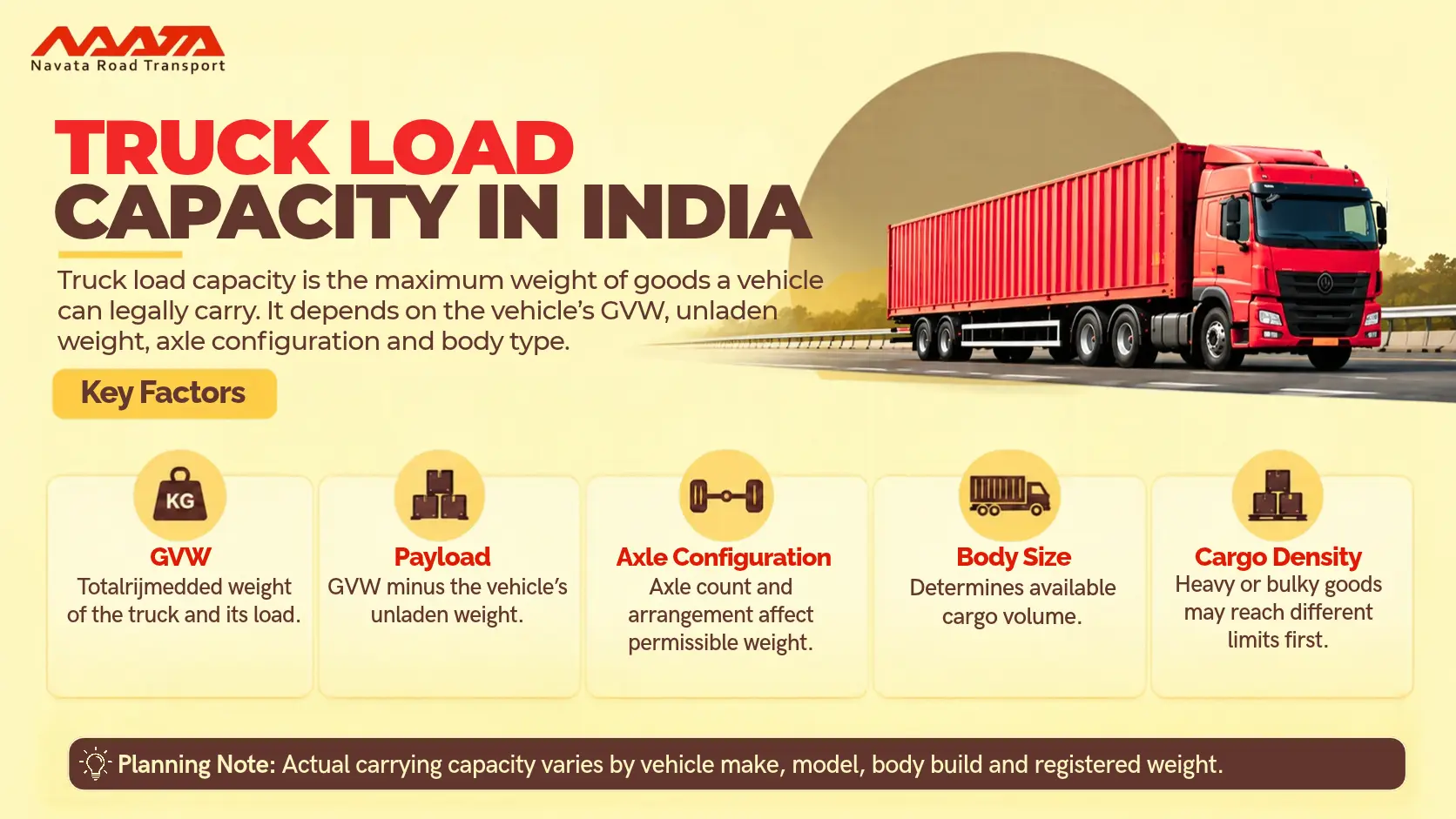
Truck load capacity in India is set by two separate limits, and a consignment is constrained by whichever it hits first. One is weight, fixed by the vehicle’s registered gross weight and its axle configuration. The other is space, fixed by the load body. A truck can run out of floor with tonnes of payload unused, or reach its weight limit with the body half empty, and the two failures cost money in different ways.
This guide covers the common vehicle sizes with indicative capacity, the body types and what each suits, a method for working out which limit binds on your particular cargo, and how that decides between a full truck and a part load.
Every figure below is an indicative planning range drawn from published industry sources. Actual capacity depends on the make, model, body build and the gross vehicle weight on the individual vehicle’s registration papers, and should be confirmed for the specific vehicle deployed.
Truck sizes in India and indicative load capacity
The truck sizes in India below are the ones most often seen on line haul and distribution work. Dimensions are approximate load body measurements and payloads are indicative ranges reported across commercial vehicle sources rather than specifications of any one model.
| Size | Indicative load body (L x W x H) | Indicative payload | Typical use |
|---|---|---|---|
| 7 to 8 ft small commercial vehicle | 7 x 4.8 x 4.8 ft | Around 0.75 to 1 tonne | Intra-city delivery, courier, small consignments |
| 14 to 15 ft | 14 x 6 x 7 ft | Around 2 to 2.5 tonnes | E-commerce distribution, market supply |
| 17 ft | 17 x 7 x 7 ft | Around 4 to 5 tonnes | Retail replenishment, light relocations |
| 19 ft | 19 x 6.5 to 7 x 6 to 7 ft | Around 6 to 9 tonnes | FMCG distribution, general industrial goods |
| 20 ft container | 20 x 7.5 x 8 ft | Around 6.5 to 10 tonnes | Enclosed regional movement |
| 22 to 24 ft | 22 to 24 x 7.5 x 7 ft | Around 8 to 11 tonnes | Regional line haul, manufacturing supply |
| 32 ft single axle (SXL) | 32 x 8 x 8 ft | Around 7 to 9 tonnes | High volume, low density cargo |
| 32 ft multi axle (MXL) | 32 x 8 x 8 ft | Around 14 to 18 tonnes | Dense cargo needing full length |
| 40 ft trailer | 40 x 8 x 8 ft | Around 25 tonnes and above | Interstate bulk and containerised movement |
These ranges are compiled from published Indian commercial vehicle and logistics sources and cross-checked across more than one of them; they are not manufacturer specifications and not Navata fleet data. Sources differ at the margins, particularly on the upper end of the 32 ft MXL and the 40 ft trailer, because payload there depends heavily on axle configuration and on the registered gross weight of the specific vehicle. Where a quotation depends on the last tonne, ask for the vehicle’s registration papers rather than working from any table, including this one.
32 feet truck load capacity: why SXL and MXL differ
The most expensive vehicle selection error on Indian line haul sits inside a single size. The 32 feet truck load capacity question has two different answers depending on axles.
A 32 ft SXL and a 32 ft MXL have the same load body, the same 32 foot floor and, at roughly 8 x 8 ft of section, close to the same 2,000 cubic feet of space. The difference is underneath. SXL is single rear axle, MXL is multi axle, and the extra axle is what permits the higher gross weight. Published ranges put the SXL at roughly 7 to 9 tonnes of payload and the MXL at roughly 14 to 18 tonnes, for identical cubic capacity.
The consequences are asymmetric and both are common:
- Dense cargo in an SXL. The vehicle reaches its weight limit with the body a third full. You pay for 2,000 cubic feet and use 700, then send a second vehicle.
- Light cargo in an MXL. You pay for the axle capacity you are not using. The body fills, the weight never approaches the limit, and the per-tonne cost is higher than it needed to be.
Neither error is visible on a booking sheet that records only “32 ft”. Specifying SXL or MXL explicitly, and matching it to cargo density, is a single-line change that removes a recurring cost.
Types of Trucks in India by body
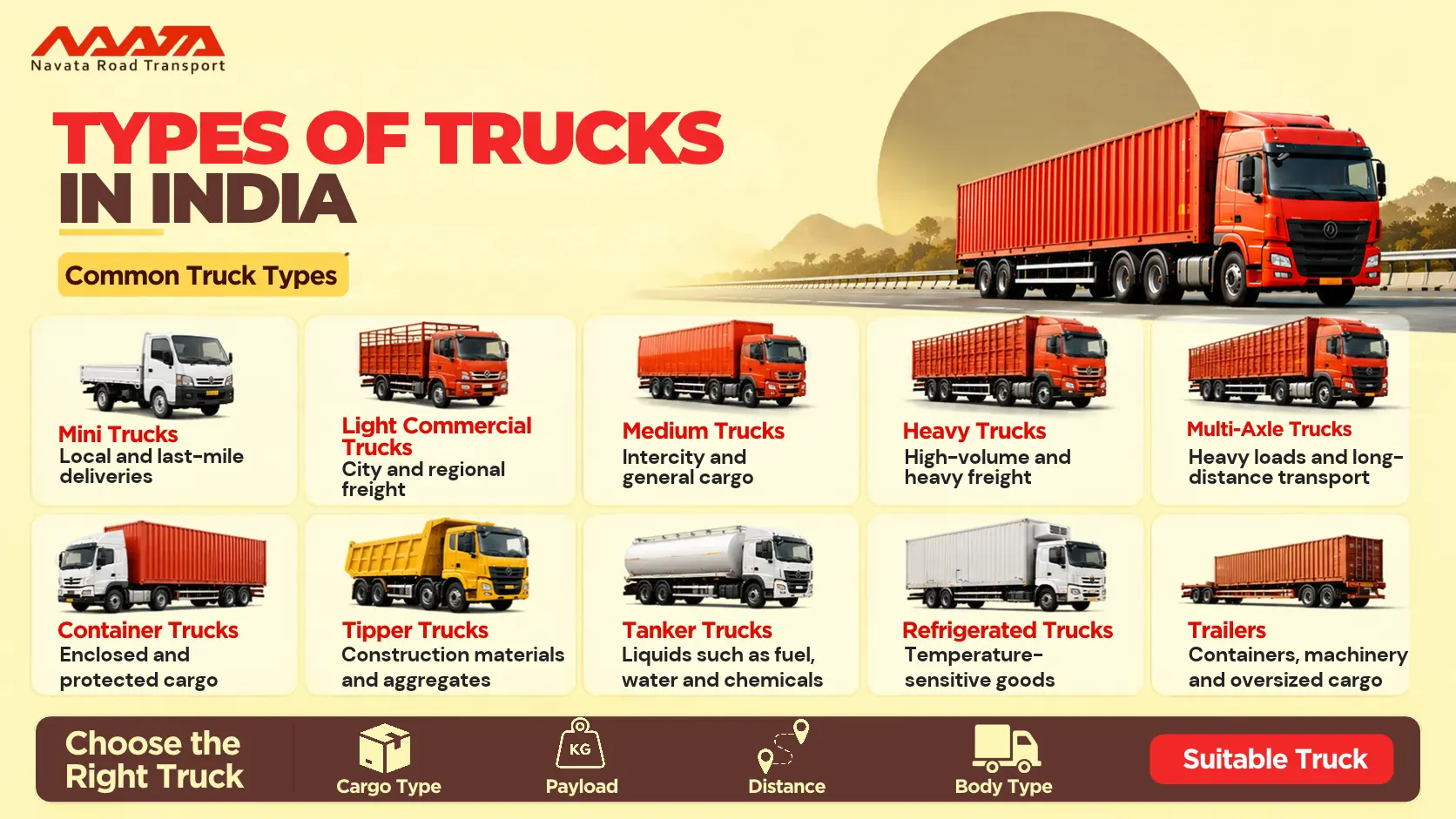
Size decides how much. Body type decides whether the cargo survives the trip and how fast it loads.
| Body type | Suits | Operational notes |
|---|---|---|
| Open body and flatbed | Steel, pipes, machinery, cement, timber, agricultural produce | Loads from sides and top, takes odd shapes and overhangs, needs tarpaulin and proper lashing |
| Closed container | FMCG, electronics, pharmaceuticals, textiles, packaged food, auto components | Weather and pilferage protection, fixed loading pattern, height limits stacking |
| Trailer and tractor-trailer | Containers, long steel, heavy machinery | Higher capacity, more route and turning constraints |
| Tipper | Sand, aggregate, coal, soil, construction debris | Hydraulic discharge, site work rather than line haul |
| Tanker | Bulk liquids, edible oil, chemicals, water | Purpose built, dedicated cleaning cycles between products |
| Refrigerated | Dairy, frozen goods, fresh produce, temperature sensitive pharma | Cost driven by temperature band and running hours, not just distance |
| Curtainside | Palletised FMCG and e-commerce | Faster side loading than a fixed container |
| Bulker and car carrier | Cement and powders, finished vehicles | Purpose built, not interchangeable with general cargo bodies |
Among the types of trucks in India in general service, the open body and closed container pair account for most general freight, and the choice between them is more often driven by handling and pilferage risk than by cargo type alone. The trade-off is set out in more detail in our comparison of containerised and open body trucks.
You may also like to read
Containerized vs Open Body Trucks
Which limit binds: a breakeven density check
Rather than memorising a general rule about heavy and light cargo, work out the break-even density of the vehicle you are considering, then compare your cargo against it.
Step 1. Cargo weight in kg, including packaging and pallets.
Step 2. Cargo volume in cubic feet. For boxed goods, length by width by height in feet, multiplied by the number of boxes. Add the space you cannot use, such as non-stackable items.
Step 3. Cargo density = weight divided by volume, in kg per cubic foot.
Step 4. Vehicle break-even density = indicative payload in kg divided by load body volume in cubic feet.
If cargo density is above the vehicle’s break-even, the movement is weight limited, and you should select on payload. If it is below, the movement is volume limited, and you should select on cubic capacity.
Using the indicative figures from the table above, the breakeven densities work out roughly as follows.
| Vehicle | Approx. volume (cu ft) | Indicative payload | Approx. breakeven density (kg/cu ft) |
|---|---|---|---|
| 19 ft | About 900 | 6 to 9 t | About 7 to 10 |
| 20 ft container | About 1,200 | 6.5 to 10 t | About 5 to 8 |
| 22 to 24 ft | About 1,150 to 1,260 | 8 to 11 t | About 7 to 9 |
| 32 ft SXL | About 2,050 | 7 to 9 t | About 3.5 to 4.5 |
| 32 ft MXL | About 2,050 | 14 to 18 t | About 7 to 9 |
| 40 ft trailer | About 2,560 | 25 t and above | About 10 and above |
These are arithmetic on the indicative ranges above, not published specifications, and they shift with the actual vehicle. The useful part is the relative picture. A 32 ft SXL breaks even at a very low density, which is why it suits bulky light freight and fails badly on anything dense. Read against that, cement, tiles, steel and packed liquids sit above almost every breakeven in the table, while packaging material, plastic mouldings, furniture and garments sit below most of them.
FTL vs part load: making the call
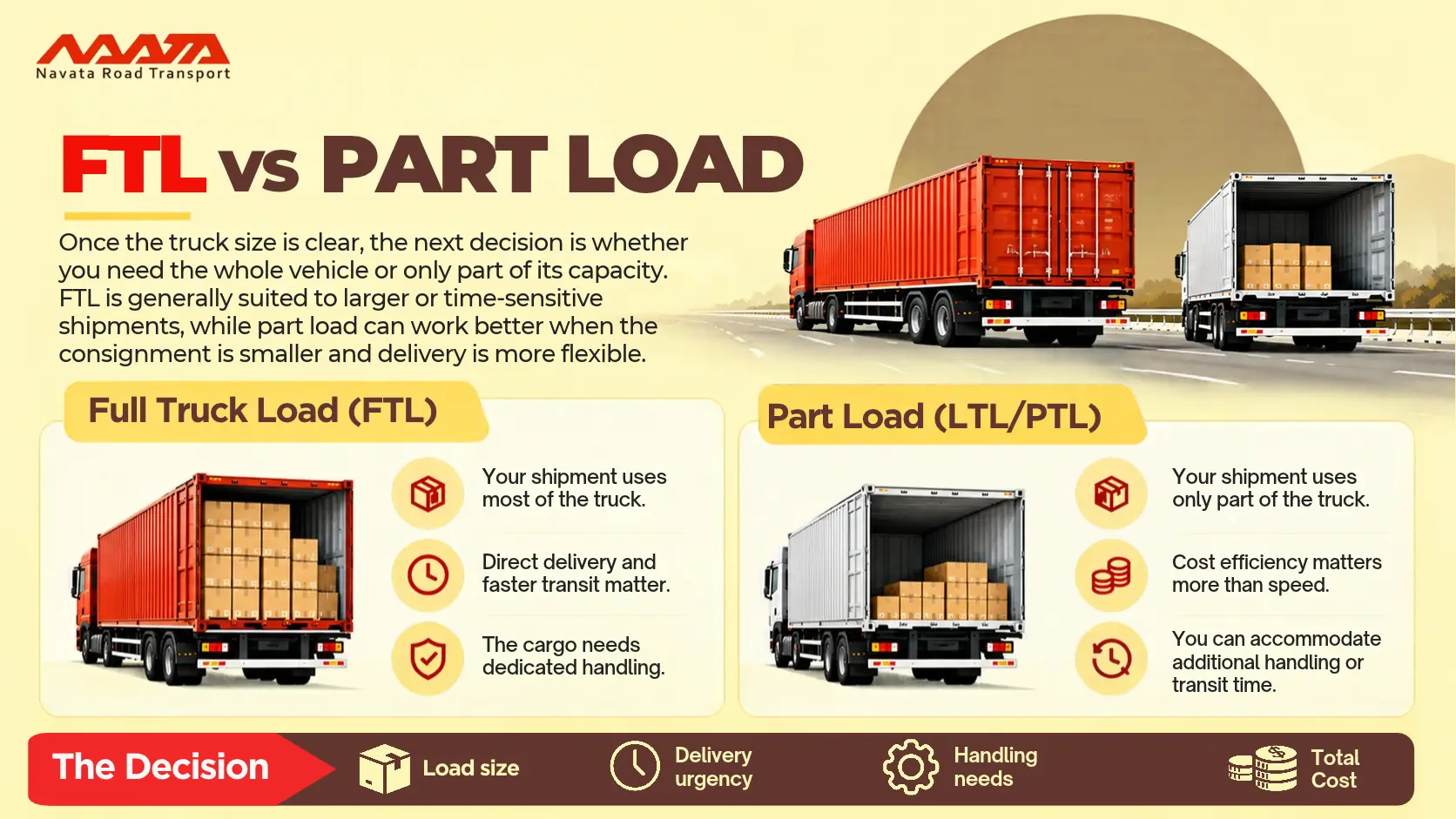
Once the vehicle class is clear, the second decision is whether you need the whole vehicle. The ftl vs part load comparison is usually presented as a cost question, which is where it goes wrong.
A full truck load tends to fit when:
- The consignment occupies most of a suitable vehicle on whichever limit binds, weight or volume
- The delivery is time sensitive, since a dedicated vehicle runs point to point without consolidation stops
- The cargo is fragile, high value, or should not be handled at transhipment points
- The movement is a single origin to a single destination
A part load tends to fit when:
- The consignment is well under a vehicle on both limits
- The lane runs frequently, so waiting for a departure costs little
- A longer and less precise transit time is acceptable
- Several small consignments are moving to different destinations
The difficult zone is a consignment that fills most of a vehicle but not all of it. Sent as a part load it can end up costing more per tonne than a dedicated vehicle once handling, transhipment risk and delay are counted, and sent as a full load it carries unused capacity. There is no universal percentage that settles this. The defensible method is to price both for your actual consignment on your actual lane and compare per tonne delivered, including the cost of the extra transit days. The mechanics of each mode are covered in our notes on FTL shipping and LTL shipping, and the two are compared directly in difference between LTL and FTL.
How the freight gets charged
Understanding which limit binds also explains the quotation.
Freight is generally charged on chargeable weight, which is the higher of actual weight and volumetric weight. Volumetric weight converts the space a consignment occupies into a weight equivalent using a divisor. For air freight the conversion is broadly standardised. For road freight it is not: the conversion factor varies by carrier, by lane and by cargo type, so the only reliable figure is the one in your own quotation.
Two practical consequences follow. Ask for the volumetric conversion factor, not just the rate, when comparing quotations for bulky cargo. And measure the consignment as it will actually be presented, on pallets and with packaging, rather than as bare product dimensions.
Axle loads, gross weight and why overloading is not a saving
Payload is not a matter of opinion. The vehicle’s gross vehicle weight is limited as per its registration and by the safe axle weight limits notified by the Ministry of Road Transport and Highways.
Notification S.O. 3467(E), issued by the Ministry of Road Transport and Highways on 16 July 2018 under section 58(1) of the Motor Vehicles Act 1988, revised those limits and superseded the 1996 position. It was amended by notification S.O. 3881(E) dated 6 August 2018. The maximum safe axle weights it sets are:
| Axle configuration | Maximum safe axle weight |
|---|---|
| Single axle, single tyre | 3.0 tonnes |
| Single axle, two tyres | 7.5 tonnes |
| Single axle, four tyres | 11.5 tonnes |
| Tandem axles, rigid vehicles, trailers and semi-trailers | 21 tonnes |
| Tri-axles, rigid vehicles, trailers and semi-trailers | 27 tonnes |
| Axle row, modular hydraulic trailers | 18 tonnes |
Vehicles fitted with pneumatic suspension are permitted one additional tonne per axle on the single-axle four-tyre, tandem and tri-axle configurations.
The same notification sets two overall ceilings: gross vehicle weight must not exceed 49 tonnes for rigid vehicles, or 55 tonnes for semi-articulated trailers and truck-trailers other than modular hydraulic trailers. The Ministry’s communication of 18 July 2018, issued under file No. RT11028/11/2017-MVL, carries an illustrative table of the resulting gross weights, running from 19 tonnes for a two-axle rigid truck up to 55 tonnes for certain tractor and semi-articulated combinations.
For comparison, the position S.O. 3467(E) superseded was set by notification S.O. 728(E) dated 18 October 1996, which allowed up to 16.2 tonnes gross for a two-axle rigid vehicle and 25 tonnes for a three-axle. The 2018 revision was a material increase in permitted capacity, not a marginal adjustment, which is why older capacity guidance still in circulation understates what a compliant vehicle can legally carry.
Two things follow for a shipper. The GVW on the individual vehicle’s registration is the operative limit, not the category maximum, so a vehicle of a given axle configuration is not automatically entitled to the ceiling. And loading beyond that limit is not a saving: it exposes the consignment to detention and penalty at weighbridges on major corridors, lengthens braking distance, accelerates tyre, brake and suspension wear, and can complicate a claim. The cost of one detention usually exceeds the saving on the trip that caused it.
Planning the load itself is a separate discipline from choosing the vehicle. Weight distribution across axles, stacking and securing all affect whether a legally loaded vehicle is also a safe one. Our note on load planning in transportation covers that side.
Site and handling checks before you book
- Access at both ends. A 32 ft vehicle is useless where the delivery point cannot accommodate more than 19 ft. Check gate width, turning radius, overhead clearance, and dock height before booking, not on arrival.
- Unloading capability. Forklift, crane, or manual labour. This often decides body type more than the cargo does.
- Stacking limits. Cargo that cannot be stacked loses much of the cubic capacity you paid for, and should be counted as occupied volume in the density calculation.
- Securing. Lashing, dunnage, and tarpaulin for open body movements are safety requirements, not extras.
- Documentation. The vehicle at the gate must match the vehicle on the e-way bill, and any change of vehicle needs the conveyance details updated before movement resumes.
- Oversize. Anything beyond standard dimensional limits moves as over-dimensional cargo, with route, permit, and escort implications. See over-dimensional cargo.
FAQs
What is the load capacity of a 32 ft truck?
It depends on axles. Published ranges put a 32 ft single axle at roughly 7 to 9 tonnes and a 32 ft multi axle at roughly 14 to 18 tonnes, for the same body size. Confirm against the specific vehicle's registered gross weight.
How do I calculate how much a truck can carry?
Payload is gross vehicle weight minus the unladen weight of the vehicle. For planning, use the indicative payload for the size, then check whether your cargo is weight limited or volume limited using the density method above.
Is a part load always cheaper than a full truck?
No. For a consignment that fills most of a vehicle, a part load can cost more per tonne delivered once handling and additional transit days are counted. Price both for the actual consignment and lane.
Which body type suits fragile or high value goods?
A closed container, for weather and pilferage protection and to reduce handling exposure at transhipment points.
What is the maximum permissible weight for a truck in India?
Notification S.O. 3467(E) of 16 July 2018 sets a ceiling of 49 tonnes gross for rigid vehicles and 55 tonnes for semi-articulated trailers and truck-trailers other than modular hydraulic trailers. The binding limit for any individual vehicle is the gross weight on its own registration, which is usually lower.
Getting the vehicle right for your lane
Vehicle selection is a network question as much as a cargo question. What runs on the lane, how often, and whether a consignment can be consolidated with others going the same way usually matter more than the vehicle table.
Navata Road Transport has operated road freight since 1982, across a branch network covering South India and several states beyond it. To size a specific movement, use the freight calculator, or find your nearest Navata branch to discuss the lane. For full truck load, part load, warehousing and 3PL, see our range of logistics services.
Dimensions, payloads and derived densities in this article are indicative planning ranges compiled from published commercial vehicle sources, not specifications of Navata Road Transport's own fleet. Actual capacity depends on the make, model, body build and registered gross vehicle weight of the specific vehicle deployed. Regulatory weight limits are taken from Ministry of Road Transport and Highways notification S.O. 3467(E) dated 16 July 2018, as amended by S.O. 3881(E) dated 6 August 2018, together with the Ministry's communication of 18 July 2018 under file No. RT11028/11/2017-MVL for the illustrative gross-weight figures, and notification S.O. 728(E) dated 18 October 1996 for the superseded position. They should be checked against any later amendment and against state enforcement practice.