
What Is Fleet Telematics? Benefits & How It Works
Table of Contents
Fleet telematics has become the operational backbone of modern fleet management. Whether you run 10 delivery vans or 500 long-haul trucks, telematics gives you real-time visibility into every vehicle, every driver, and every dollar spent on the road.
This guide covers exactly what fleet telematics is, how it works, the measurable benefits, and how to calculate the ROI before you commit to a system.
What Is Fleet Telematics?
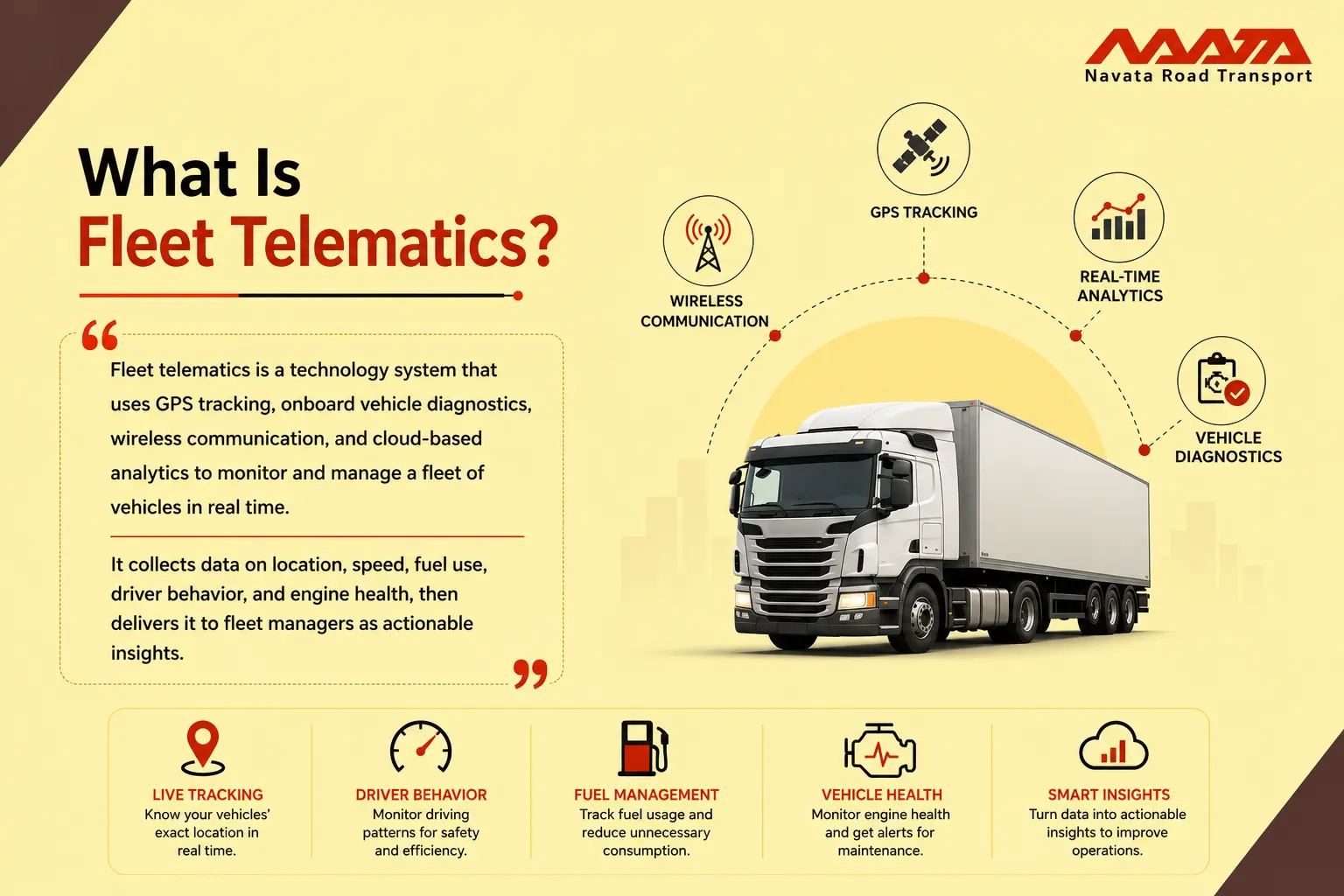
Fleet telematics is a technology system that combines GPS tracking, onboard vehicle diagnostics, wireless communication, and cloud-based analytics to monitor and manage a fleet of vehicles in real time. It collects data on location, speed, fuel use, driver behavior, and engine health then delivers it to fleet managers as actionable insights.
The word ‘telematics’ combines ‘telecommunications’ and ‘informatics.’ In a fleet context, it means the complete technology stack hardware in the vehicle, the network that transmits data, and the software that turns raw readings into decisions.
How Fleet Telematics Works
Fleet telematics works in three stages: (1) an onboard device reads GPS position and engine data from the vehicle’s ECM via the OBD-II port or J1939 bus; (2) that data transmits in real time over 4G LTE or satellite to a cloud server; (3) fleet management software processes it into dashboards, alerts, and reports.
Stage 1 — Data Collection
A telematics device (also called an On-Board Unit or OBU) plugs into the vehicle’s OBD-II port (standard on vehicles built after 1996) or connects via the J1939/J1708 bus in commercial trucks. It reads the Engine Control Module (ECM) directly.
Data captured at this stage:
- GPS coordinates — updated every 1–30 seconds
- Vehicle speed, RPM, and acceleration patterns
- Fuel consumption rate and idle duration
- Diagnostic Trouble Codes (DTCs) — fault alerts from the engine
- Harsh braking, sharp cornering, rapid acceleration (G-force data)
- Odometer readings and total engine hours
Stage 2 — Transmission
The OBU stores data locally for brief periods, then sends it to the cloud via:
- 4G LTE cellular — the standard for most road-based fleets
- 5G — emerging for high-density urban operations requiring low latency
- Satellite — used in remote regions where cellular coverage is unavailable
Stage 3 — Analytics and Action
The OBU stores data locally for brief periods, then sends it to the cloud via:
- 4G LTE cellular — the standard for most road-based fleets
- 5G — emerging for high-density urban operations requiring low latency
- Satellite — used in remote regions where cellular coverage is unavailable
Benefits of Fleet Telematics
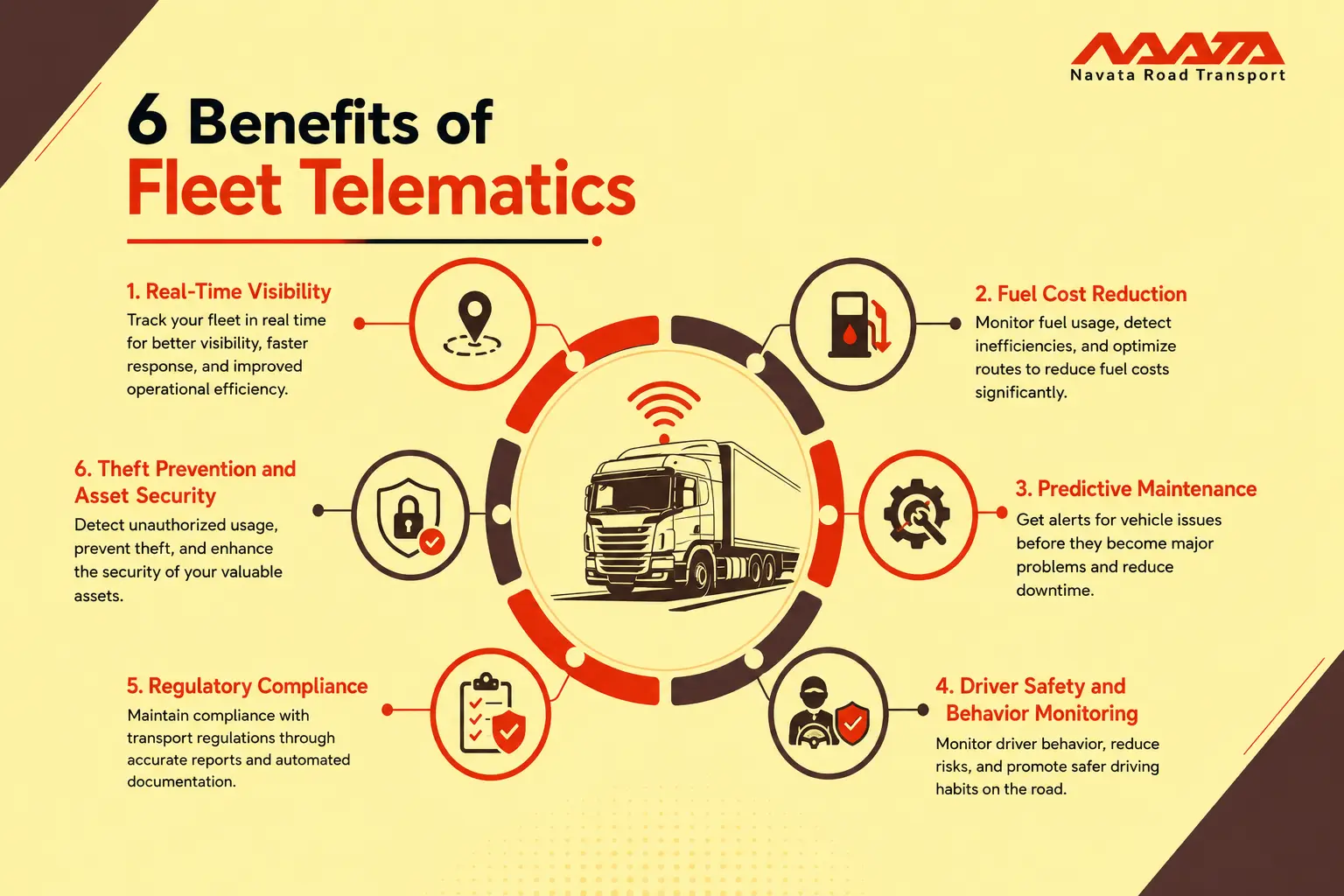
The core benefits of fleet telematics are: real-time vehicle visibility, 10–25% fuel cost reduction, 30–40% less unplanned downtime through predictive maintenance, measurable driver safety improvements, automated regulatory compliance (ELD, IFTA), theft prevention via geofencing, and better customer delivery accuracy — typically delivering full ROI within 6–12 months.
1. Real-Time Visibility
Know where every vehicle is, its speed, and whether it is on schedule — right now. Dispatchers can reroute vehicles around traffic in real time, reduce idle time, and respond to delays before customers notice. This alone eliminates dozens of status-check phone calls per day.
2. Fuel Cost Reduction
Fuel accounts for 25–35% of total fleet operating costs. Telematics reduces this through:
- Idle time alerts — excessive idling wastes 0.8 gallons per hour per vehicle
- Driving behavior coaching — reducing hard acceleration and speeding improves fuel economy by 5–10%
- Route optimization — shorter, smarter routes mean fewer miles driven
- Fuel card fraud detection — GPS cross-references fuel transactions to location
Fleets deploying telematics typically achieve 10–25% fuel savings within the first 12 months.
3. Predictive Maintenance
Telematics reads Diagnostic Trouble Codes (DTCs) directly from the engine ECM and triggers maintenance alerts before minor issues become roadside breakdowns. Industry research shows a predictive maintenance approach reduces unplanned downtime by 30–40%. Maintenance scheduling shifts from fixed calendar intervals to data-driven service triggers based on actual mileage and engine readings.
4. Driver Safety and Behavior Monitoring
Telematics tracks and scores every trip on:
- Speeding events — frequency, severity, duration
- Harsh braking and aggressive cornering
- Rapid acceleration patterns
- Seatbelt compliance
Driver scorecards create measurable accountability. Fleets report 20–30% reductions in accident frequency after implementing telematics-driven safety programs. Coaching becomes data-led, not assumption-based.
5. Regulatory Compliance
For commercial carriers, compliance automation is one of the highest-value telematics applications:
- ELD mandate — automatically generates FMCSA-compliant Hours of Service (HOS) records
- IFTA fuel tax — mileage-by-jurisdiction captured automatically from GPS logs
- DVIR — digital pre/post-trip vehicle inspection reports submitted via mobile app
- DOT roadside inspections — all inspection-ready data is available digitally, no paper logs
6. Theft Prevention and Asset Security
Geofence alerts notify managers the moment a vehicle moves outside an authorized zone outside operating hours. Real-time GPS dramatically speeds up vehicle recovery. For trailer fleets, non-powered asset trackers extend this protection to every asset in the yard and on the road.
Fleet Telematics ROI: What to Expect
Fleet telematics ROI is typically achieved within 6–12 months. For a 50-vehicle fleet, annual savings from fuel, maintenance, accidents, and insurance can total $45,000–$127,000 against a typical telematics spend of $24,000 per year — a net return of $21,000 to $103,000 in year one.
What Does Fleet Telematics Cost?
Cost Type | Range | Notes |
OBD-II plug-and-play hardware | $50–$150 / vehicle | Light commercial vehicles and vans |
Hardwired OBU (commercial trucks) | $100–$350 / vehicle | Full engine data access via J1939 |
Software subscription (standard) | $25–$40 / vehicle / month | Full telematics + maintenance + driver scoring |
Software subscription (compliance) | $40–$65 / vehicle / month | Adds ELD, IFTA, advanced analytics, API |
ROI Calculation — 50-Vehicle Fleet Example
Savings Category | Annual Saving (50 vehicles) |
Fuel reduction (15% of annual fuel spend) | $18,000 – $45,000 |
Maintenance cost reduction (20%) | $10,000 – $25,000 |
Accident frequency reduction (25%) | $8,000 – $30,000 |
Insurance premium reduction (10%) | $4,000 – $12,000 |
Driver overtime / idle reduction | $5,000 – $15,000 |
TOTAL ANNUAL SAVINGS | $45,000 – $127,000 |
Annual telematics cost (50 vehicles × $40/mo) | $24,000 |
NET ROI — YEAR 1 | $21,000 – $103,000 |
Most fleets achieve payback in 6–12 months. Larger fleets and operations with high fuel spend or frequent accidents tend to see ROI in under 6 months.
Before presenting to leadership, calculate these four numbers for your fleet:
- Annual fuel spend — telematics typically cuts this by 10–25%
- Annual maintenance and breakdown costs — expect 20–30% reduction
- Accident frequency and average cost per incident — telematics reduces accident rates by 20–30%
- Annual insurance premiums — documented safe driving history can reduce this by 5–15%
Add those savings together, subtract the annual telematics subscription cost, and you have your net ROI estimate.
Thank You For Reading: Fleet Telematics: Data-Driven Insights Redefining Transport Efficiency
Powered By 360Presence
FAQs
Q1: What is fleet telematics?
Fleet telematics is a system that combines GPS hardware, cellular communication, and cloud analytics to monitor and manage vehicles in real time. It captures location, engine data, fuel use, and driver behavior from an onboard device, transmits it via 4G LTE or satellite, and presents it through a software platform as dashboards, alerts, and reports for fleet managers.
Q2: What is the difference between fleet telematics and GPS tracking?
GPS tracking shows only where a vehicle is located. Fleet telematics includes GPS location plus engine diagnostics, fuel consumption, driver behavior scoring, maintenance alerts, and compliance data read from the vehicle’s Engine Control Module (ECM). Telematics is a complete fleet intelligence platform; GPS tracking is one input within it.
Q3: How much does fleet telematics cost?
Fleet telematics hardware costs $50–$350 per vehicle, depending on the unit type. Software subscriptions run $25–$65 per vehicle per month. For a 50-vehicle fleet, the annual total is typically $20,000–$45,000. Most fleets achieve full ROI within 6–12 months through fuel savings, reduced maintenance costs, and lower accident rates.
Q4: What data does a fleet telematics system collect?
A fleet telematics system collects GPS location, vehicle speed, engine RPM, fuel consumption, idle time, Diagnostic Trouble Codes (DTCs), odometer readings, and driver behavior data — including harsh braking, rapid acceleration, speeding events, and seatbelt compliance. All data is timestamped and geo-tagged, and accessible via web dashboard or mobile app.
Q5: How long does it take to implement fleet telematics?
Hardware installation takes 30–90 minutes per vehicle for plug-and-play OBD-II units, or 2–4 hours for hardwired commercial units. Software setup and driver onboarding takes 2–4 weeks for a 10–50 vehicle fleet. Most fleets reach full operational optimization — actively managing KPIs — within 60–90 days of deployment.
Recent Posts